Category Archives: Jewelry

Christmas in East Hampton

This is a special Christmas and Holiday season 2012.  At least for us.  We are travelling for a family gathering and there is no need for a tree and all the usual sparkly decorations.   But on my walk this morning in the dog park (in Springs East Hampton) I spotted a little lonely evergreen which looked quite adorable in the morning mist, better than any tree that we could have purchased.

Christmas Tree "in the rough"

Christmas Tree “in the rough”

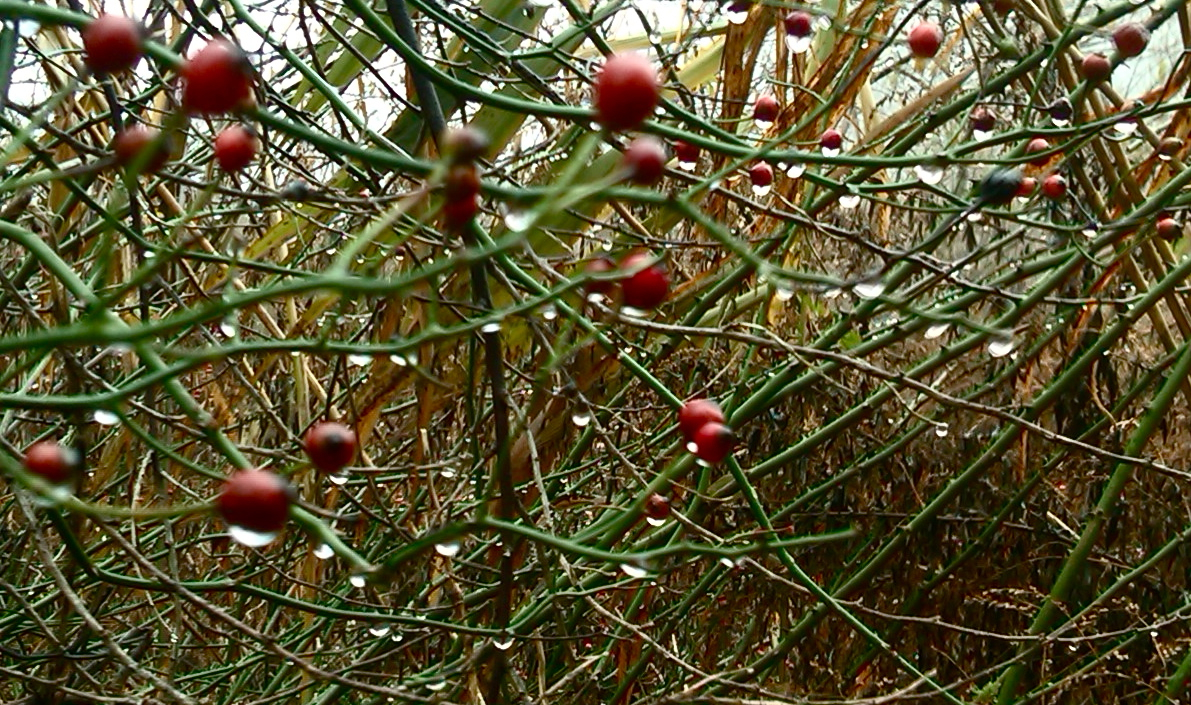
There were twigs with red rose hip and a rainy morning had left glittering rain drops as sparkling decorations.  Who needs  a Christmas tree with such natural splendor?

Red Rose Hip and Raindrop Sparkles

Red Rose Hip and Raindrop Sparkles

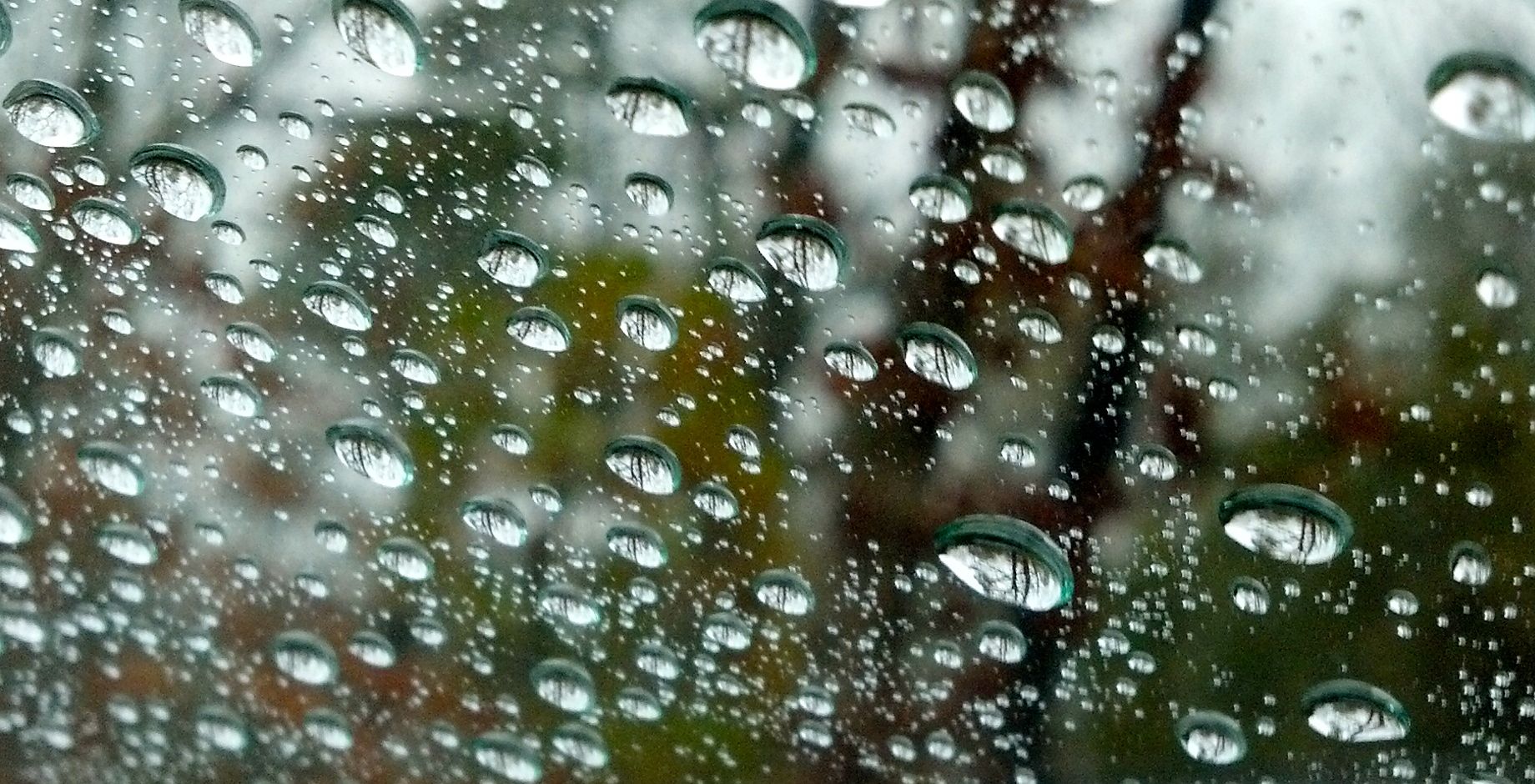
My daughter Yelyi agrees that raindrop sparkles are festive. Here is her picture taken through the car window.

Rain Drops

Rain Drops (Yelyi Nordone)

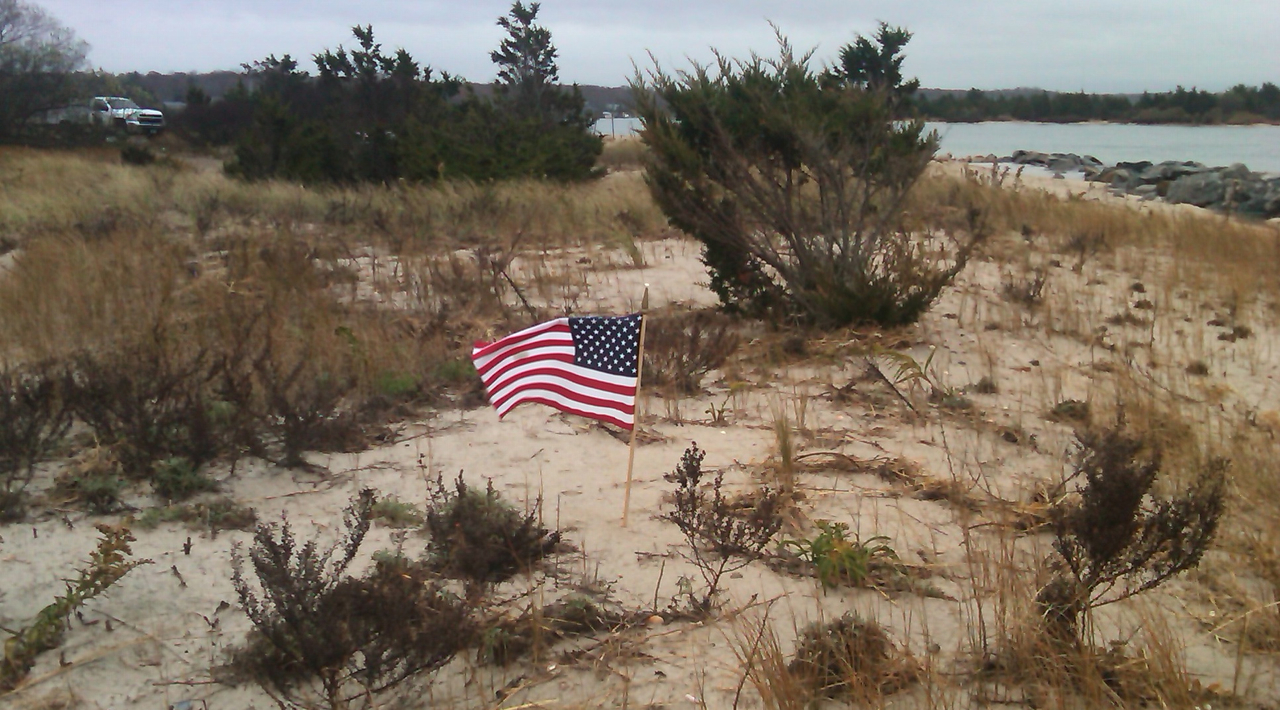
There are other reasons to be thankful. Mother nature with all her might taught us all a lesson just weeks ago, see my earlier post.  Families right here on Long Island are still struggling with major damage to their homes and cars.   Our beach is now back to “normal” but a small flag serves as a reminder.

Flag on our Beach

Flag on our Beach

Our beach (Maidstone Park Beach) has other treasures and keeps on surprising me.  There is a lone couple of Great Blue Herons that have stayed “home” this year. Occasionally these majestic birds do not migrate and take their chances.  According to Cornell University’s ornithology site, Long Island is apparently in the zone where  Great Blue Herons can stay all year round.  I have been observing them for the last few weeks. They hang out at the same place every day known for an abundance of shell fish.  One of them stays close to shore but usually scatters when I appear with my German Shepherd!  It is beautiful to watch them fly just a few feet above the waters of 3 Mile Harbor.

Great Blue Heron

Great Blue Heron

Our beach has other treasures such as stunning views of the sunset.

Winter Sunset over Maidstone Park

Winter Sunset over Maidstone Park

Who could ask for more.

Closing Pin for Sky Diving

The sister of my friend recently called and asked for a closing pin pendant for a necklace.  I responded “a closing what?”

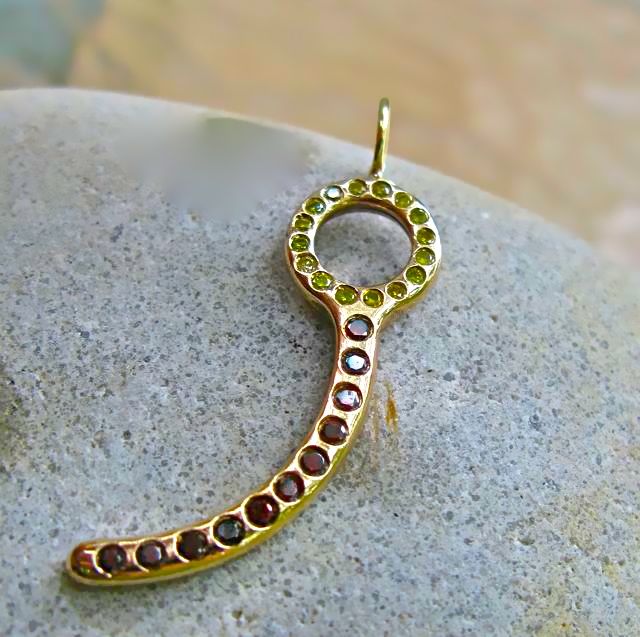
It turns out that she and her fiancée are sky divers.   She was getting a gift for him.   Closing pins are about one inch long and shaped like the number 9 (sort of).  They are essential gear for the release of the parachute.  You have to pop the pin to allow the main canopy to escape from a container.  This pin is so essential, that if it gets stuck, you are dead unless you have a backup chute.

Sky divers seem to worship this pin.  And many of them wear the pin as a pendent on a necklace.  There are several places where you can buy them.  Just google “closing pin necklace” or click here.

The pin ordered was going to be special: made in gold with red and yellow diamonds representing the colors of the canopy of the chute.

Image

So now I know a little bit about sky diving.  And if papa Bush can do it, hell, I might try one day.

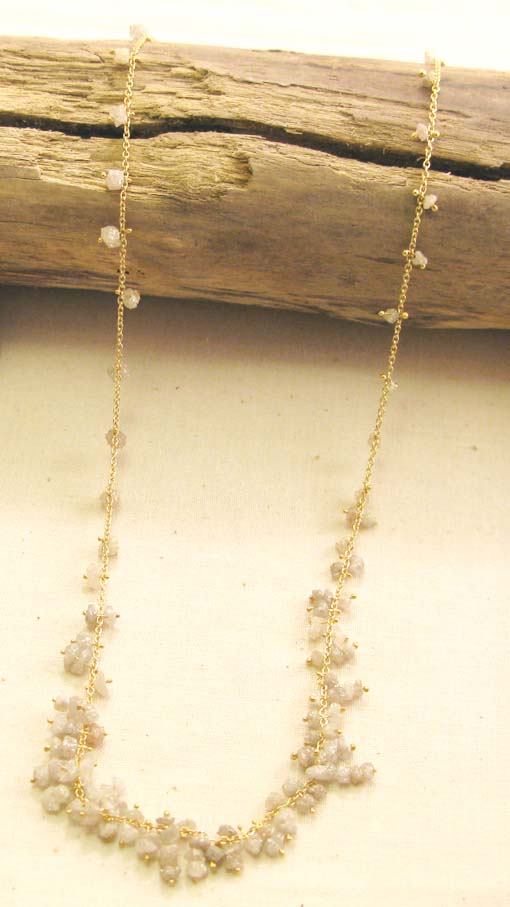
Delicate & Graceful Diamond Necklace

You would not think that rocks can be sexy, seductive, elegant, graceful and feminine! Would you?  Well, it is a bit different if we are talking diamond “rocks” as in this necklace:

Image

Diamonds naturally crystalize in cubes and these little grey diamonds in the rough are each drilled.  A tiny gold wire (28 gauge) is then inserted through the diamond and balled up with a minute flame from an acetylene torch and attached to a fine and elegant 18 karat gold chain.  Since the flame comes so close to the diamond, this will heat up the diamond to a very high temperature.  This technique can only be used with diamonds because other gems are less heat tolerant. Never the less, occasionally a diamond will zing!!  That’s when it splits and the pieces fly through the studio!

Because the diamonds are in the rough, there is an organic quality to this necklace.  Sometimes I get comments such as “exquisite”, “sophisticated” and “charming”.  But what I really think:  this was a huge “labor of love”.

Choosing Diamond Bits to Drill Beach Stones with a Dremel

Jewelers, beading and lapidary enthusiasts, and those that work with sea glass have a common problem:  How to make a hole in their material, be it stone, precious or semiprecious gems, or glass.

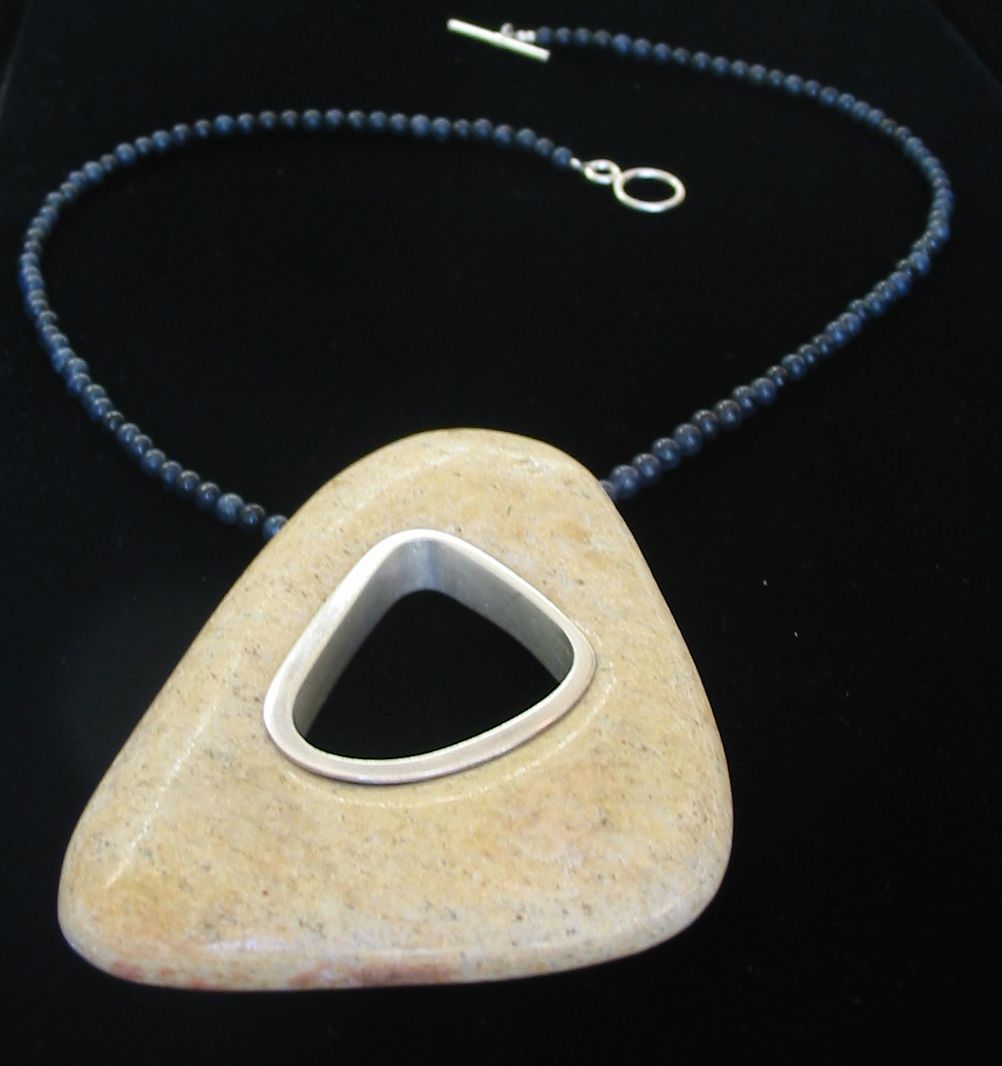
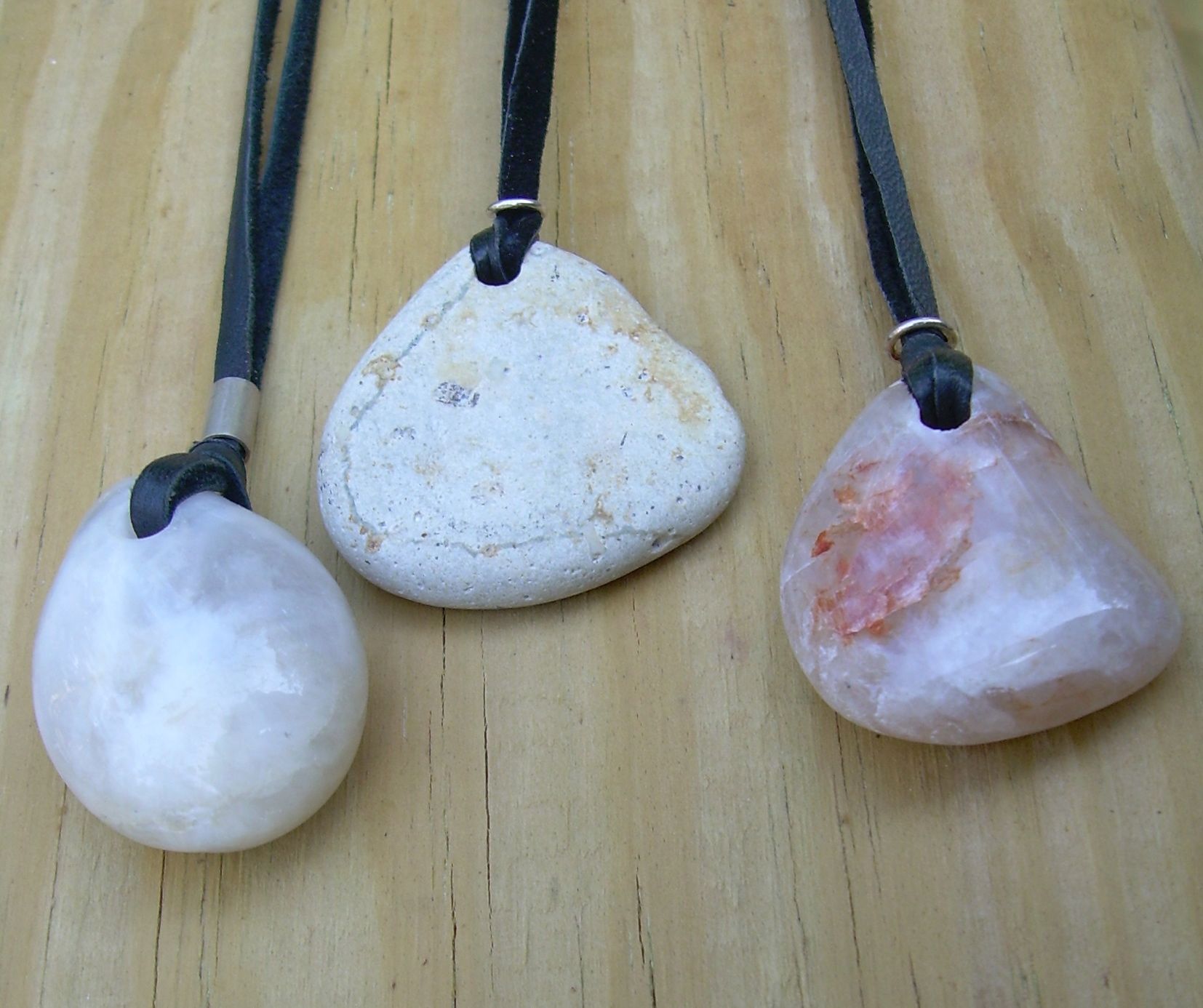
Drilled beach stone

Drilled Beach Stone with Silver Inlay

I have worked with beach stones for about 12 years.  They come in different hardness measured on a 1-10 Mohs’ scale.  The quarzites are hard (7 on the Mohs scale) and the sedimentary or sand stones are much softer (about 3-5 on the Mohs scale) and therefore easier to drill.  We use a Dremel drill.  Take a look at the comments to this post about different models of Dremel drills.  We use cylinder drill bits that are coated with diamond dust (simply called diamond drill bits).  I buy them in bulk because we use so many.  I am out of bits again and I just scoured the web for suppliers.  This post is about how to choose a supplier!  Drill bits come in very different quality, so you want to choose carefully.

First, lets consider the different types of bits.  There are  1) cylinder bits, 2) twisted bits, 3) shank bits, 4) core bits, 5) crinkled core bits, 6) cintered core bits. If you are not sure what this means you can check out pictures of these bits at Dad’s Rock Shop.  I have tried choices 1-4.  Considering the cost, I still prefer the simple cylinder bits or the twisted bits. They are much cheaper.  Most sources have a variety of sizes to offer.  And you can buy in bulk.  They work for really hard stones and they work with glass.   In terms of how long they last before they are totally dulled up, it’s your technique which is most important: drill slowly, under water to keep everything cool and with a relatively slow rpm (<2000).   Drill even more carefully and without exerting much pressure if you are making a hole in glass.

So, once again I have decided to go with cylinder bits and I want diameters of 1-2 mm.  I usually order large quantities, say 300 – 1000 bits.  I did a google search for  ‘1 mm diamond drill bits’.  Here is what I got.  The prices are per drill bit.

Dad’s Rock Shop  $3.50 (no discount for large quantities)

Lasco Diamond Products $1.75 (1.5mm Diamond drill bits only)

By The Bay Treasures  $2.30  (min 50 bits)

Delta One Lapidary  $1.85 (min 12 bits)

Twisted bits on Ebay $0.35 (20 bits)

Thunderbird Supply Co.  $1.32 (min 30 bits)

Covington Engineering  $1.00 (min 50 bits)

Daniel Lopacki  $0.95 (min 100 bits)

I read every web site in detail and looked at the “about” section.  That tells me whether the seller has first hand experience with drilling stones.   I have previously bought drill bits (and other stuff) from Dad’s Rock Shop.  They are good quality, but their current prices are not competitive.  I have bought poor quality bits too, but not from any of the suppliers mentioned above.  I was somewhat interested in the drill bits from Bay Treasures because these are clearly lapidary enthusiasts and concerned with quality products.  However, I think I am going to go with Daniel Lopacki.  His prices are very competitive if you buy in bulk.  And the website includes great tips for drillers.  They know how to do it and have done it themselves and quality bits are a concern for this seller too.  As you can see, you can get bargains on Ebay.  I have had variable success with these bits depending on the vendor.  But check out the comments below, because Seth from fans4pc managed to change my mind on his diamond bits which are both well priced and good quality.

For drilling holes in glass, check this new post out!

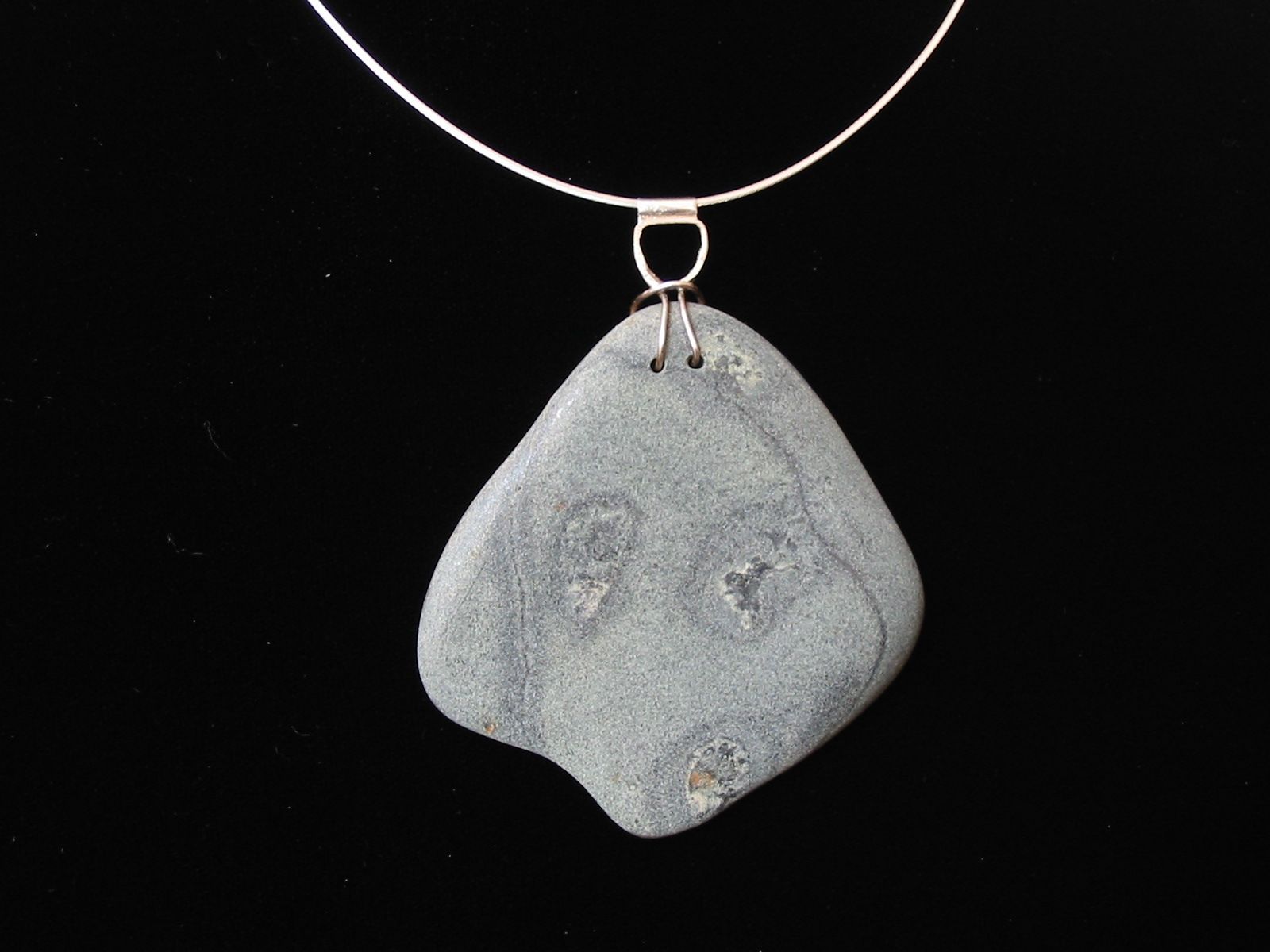
Drilled Beach Stone – Sterling Silver

Drilled Beach Stone – Sterling Silver

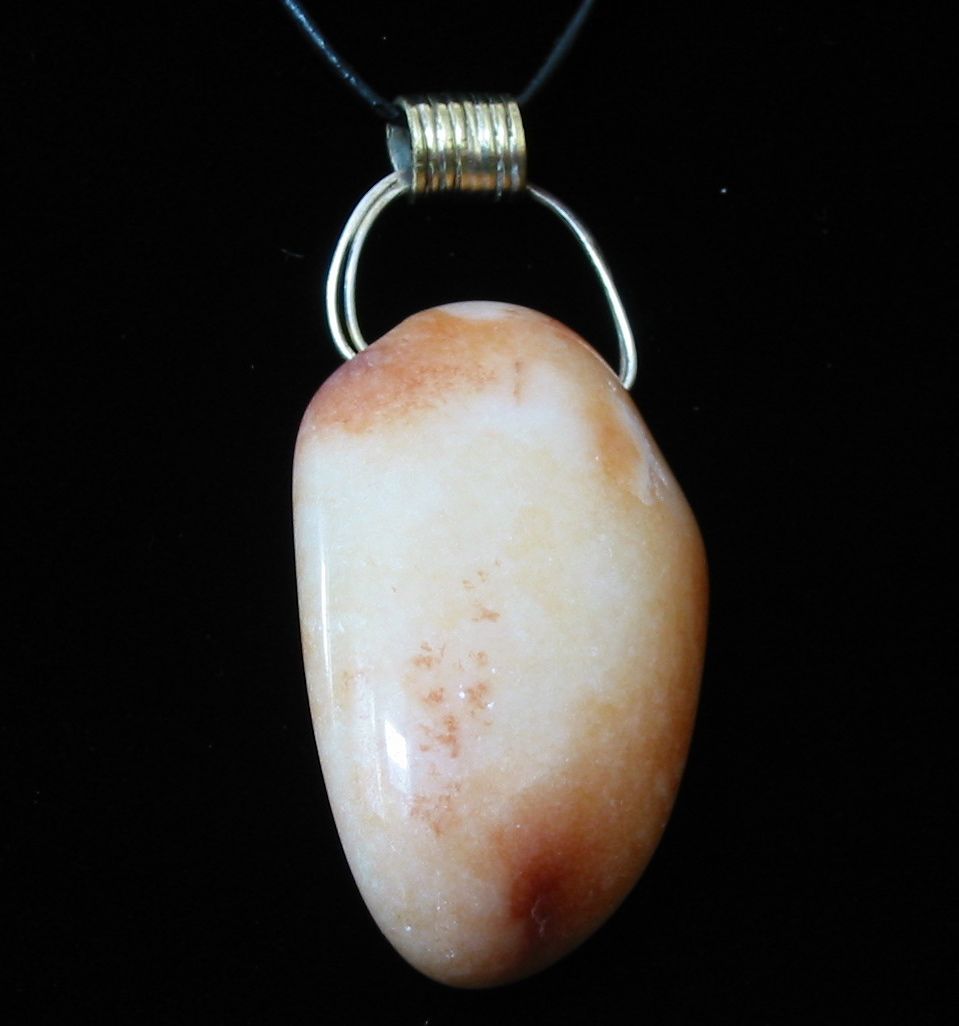
Drilled Beach Stones – Deer Skin Leather

40 BEACHES OF EAST HAMPTON

I was sitting at the kitchen table with my wife not too long ago, wondering how it was possible that I have lived here on the East End of Long Island for over 30 years and have not yet visited all the beaches of East Hampton Town.  So we made a vow to walk all 40 beaches of this town and record our observations on this blog!    We thought it might be useful as there are no in depth beach guides for this area (either on the web or in print) and, in the summer at least, this town is a major destination for beach visitors.

This is a series of 7 blog posts and they are each on a separate page -> check out the top of  the side bar or you can click here 40 Beaches of East Hampton!   You can also click on whatever beach you are interested in on the list below…. Just in case you are wondering…these are gorgeous beaches.

Take care, David

I Sag Harbor and Northwest Beaches

1) Foster Memorial Beach (Long Beach)

2) Haven’s Beach, Bay Street

3) Barcelona Neck beach

4) Northwest Landing Rd beach

5) Mile Hill Rd beach

6) Cedar Point Park beaches

II Three Mile Harbor and Springs Beaches

7) Sammy’s Beach

8 ) Maidstone Park Beach

9) Lion Head Beach

10) Kings Point Rd Beach

11) Gerard Drive, Gerard Point

12) Louse Point Beach

III Amagansett, Napeague and Hither Hills Bay Beaches

13) Barnes Landing Beach

14) Albert’s Landing Beach

15) Abraham’s Landing Beach

16) Promised Land and Lazy Point Beaches

17) Napeague Harbor Beaches

18) Hither Hills Beaches

IV Montauk Bay Beaches

19) Navy Rd Beaches

20) Culloden Point

21) Gin Beach

22) Oyster Pond

23) North Rd beaches

V Montauk Ocean Beaches

24) Old Montauk Highway – Camp Hero Beaches

25) Cliff Drive Rd

26) Ditch Plains Beach (including Rheinstein Estate Park & Shadmoor Park)

27) Montauk Beaches

28) Gurneys Inn Beaches

29) Hither Hills Campground Beaches

VI Napeague, Amagansett Ocean Beaches

30) Napeague Stretch Beaches

31) Beach Hampton

32) Atlantic Beach

33) Indian Wells Beach

VII East Hampton and Wainscott Ocean Beaches

34) Two Mile Hollow Beach

35) Wiborg Beach

36) Main Beach East

37) Main Beach West

38) Georgica Beach

39) Wainscott Beach

40) Sagg Main Town Beach

BEACH GLASS & SEA GLASS

“Do you have beach glass jewelry?”  That is a question I often get when I am exhibiting at an Arts & Crafts Fair.

So, yes, I do work with beach or sea glass, terms which are often used interchangeably (see the images in this post).  As any beachcomber knows, a nice piece of glass is a good find.  An uncommon color, a well worn piece (which is old), a recognizable lettering or name that can help date the piece, these are features we all look for.

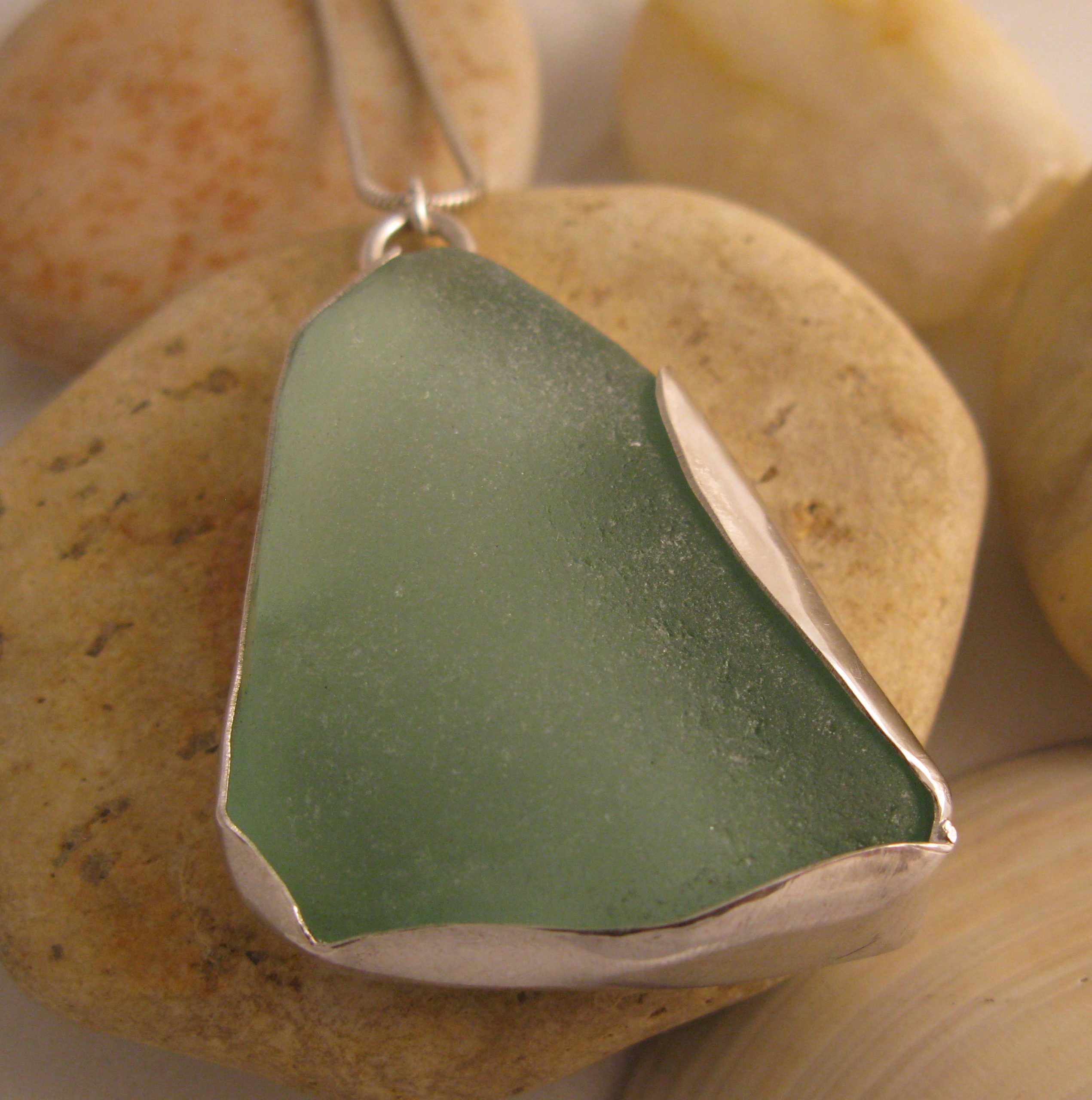
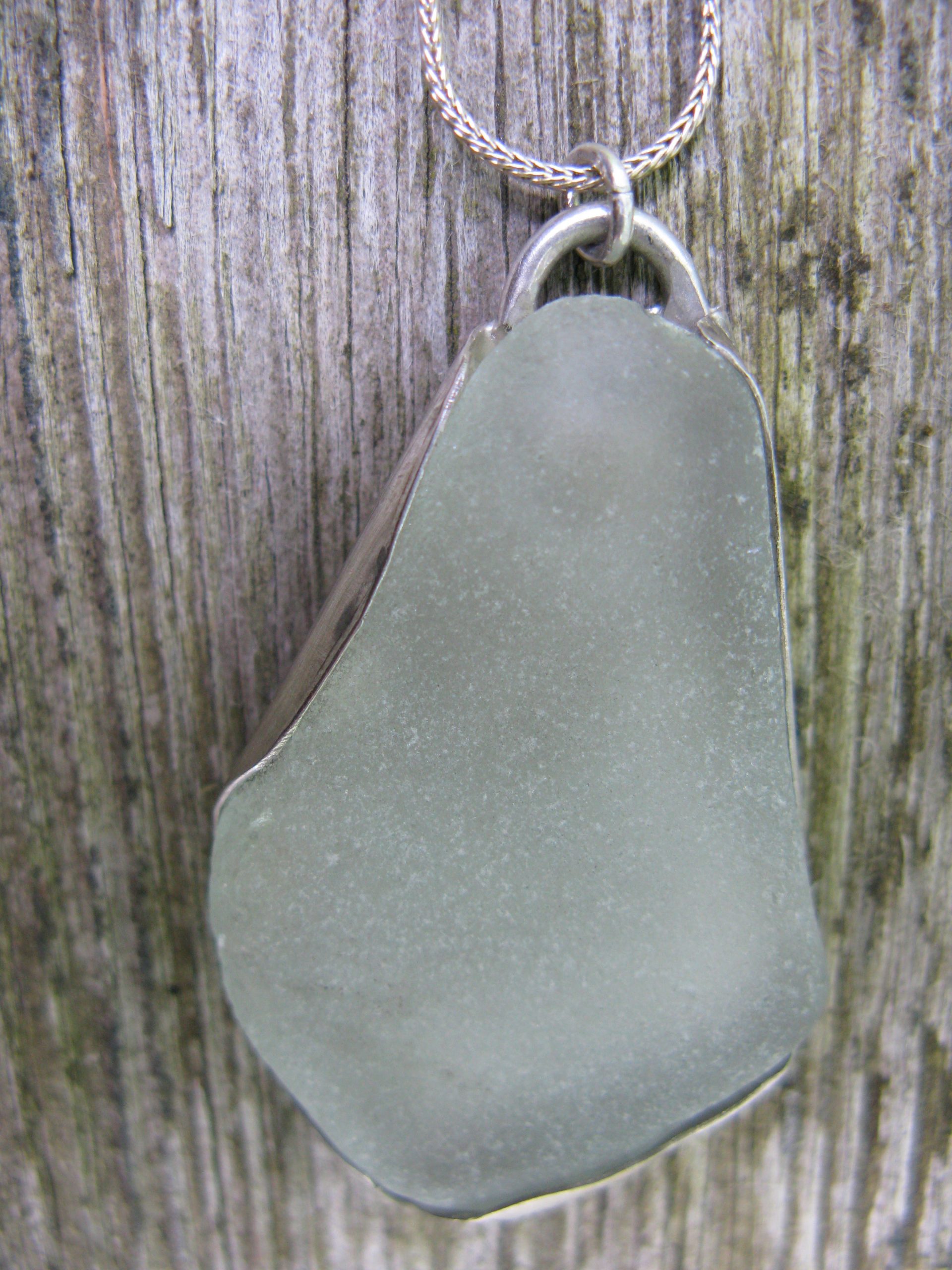
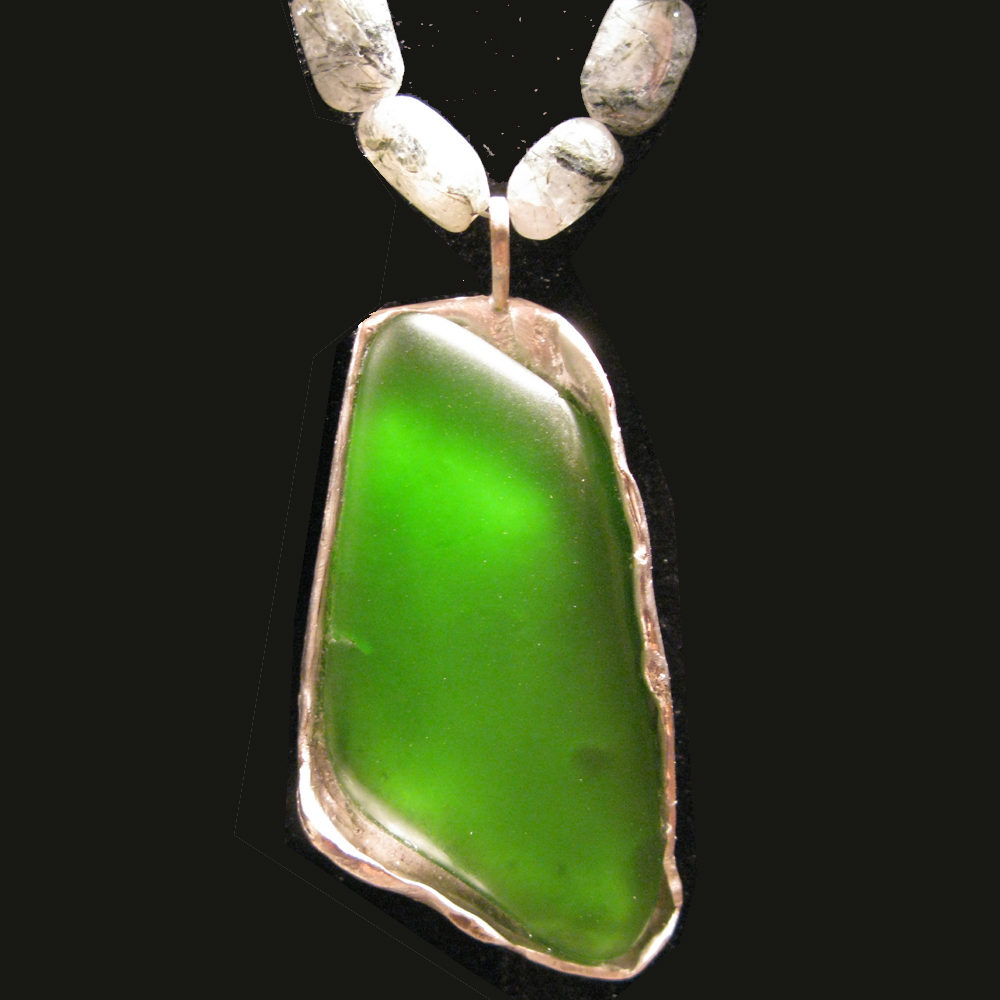
Green Sea Glass pendent in Silver

I have learned that beach glass is very popular.  A search on the etsy.com website for “beach glass” got 12,484 hits and a search for “sea glass” got 22,050 hits.  Those are items for sale, either handmade jewelry, vintage pieces or supplies (such as bundles or bulk lots of beach glass).   Even with so many buyers and sellers, there is surprisingly little knowledge on this product.  So I tried to educate myself and researched the web on beach glass and found some interesting stuff.

Sea Glass Pendent in Silver

The Wikipedia page on “Sea Glass” is informative.  It is particularly strong on the colors that are sought after and links each color to the possible source: for example red sea glass from old Schlitz beer bottles (1900-1982).  Schlitz was a brewery in Milwaukee, Wisconsin, which became Stroh Brewery and is now Pabst Brewing Company.  As with red glass of Schlitz bottles, there are many examples where the particular color helps to date the glass.

Much of this information comes from a book written by LaMotte, who is referred to as the “Godfather of  Sea Glass”.   LaMotte together with Charles Peden founded the North American Sea Glass Association (NASGA).  Their website has news about the Sea Glass Festival in October.  A very useful page compares natural (genuine) sea glass, versus “craft glass” (or artificial glass) tumbled in drums rather than by the action of waves over many years.   You can also find information on antique bottle collecting and a link to Antique Bottle Collector’s Haven!  On this site you can appraise your antique bottle and date it.

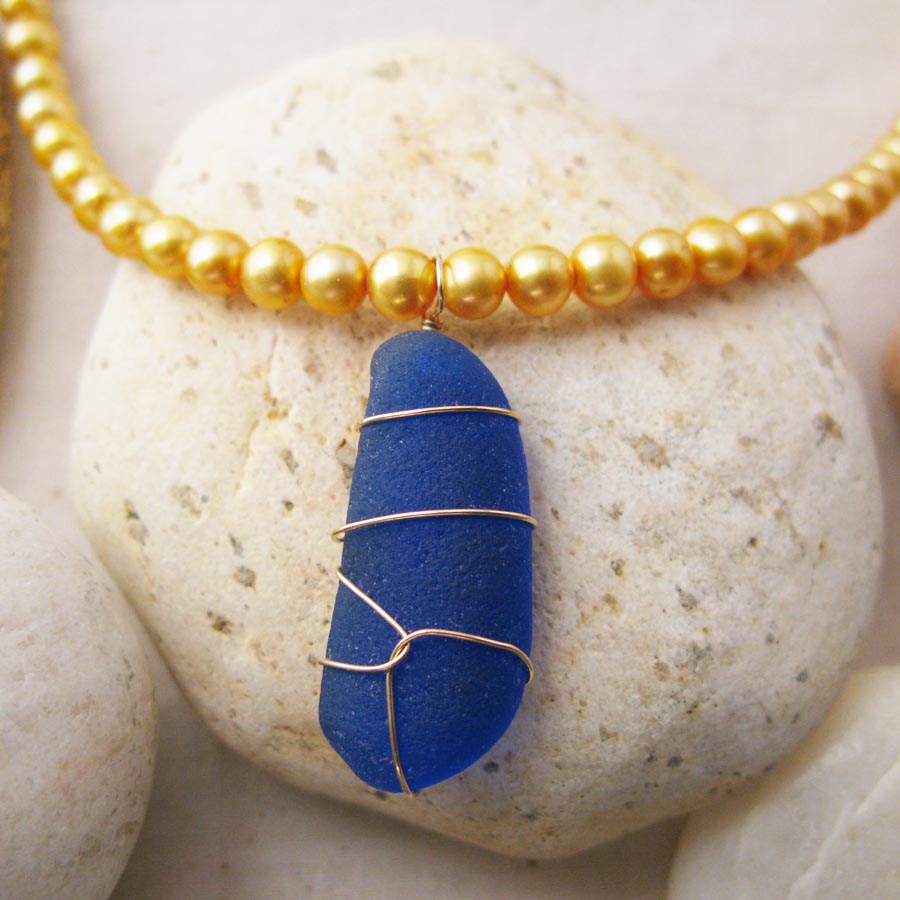
Blue Sea Glass pendent

An interesting article describes the amethyst color brought out by sunlight over the years.  It is due to manganese dioxide that was added to glass prior to the 1920s to produce colorless glass by counteracting the natural green hue from iron.  Manganese when exposed to UV light over the years turns to an amethyst color.

Green Sea Glass Pendent in Silver

A frequent query is about which beaches have sea glass.  It turns out that old dumping sites are where you need to go.  There are a few well know ones such as Glass Beach in Fort Bragg CA.   But also many others world wide.  Storms are supposed to unearth old sites of beach glass.  But I think you are better off asking locals about where the town dump used to be 50-100 years ago!  A how-to-method for walking the beach and scouring for beach glass can also be found on the web.  I have a page on the 40 Beaches of East Hampton town.  Some of these beaches contain lots of sea glass, in particular around the ‘Promised Land’!

Finally I found an interesting story about Louise Rogers who made a fortune with her hobby of collecting sea glass.  She has over a million pieces that she found personally.

For now,  take care and happy beachcombing.  David

Genie, is a dear friend.  She reminded me of this piece I made for her a few years ago.  It is a glass bottle neck with a sapphire in silver.  I had forgotten about it!  (photo courtesy of Genie Posnett)

Genie’s Sea Glass Necklace

I have also got some new sea glass pieces listed in ETSY.

Red Diamonds

Most of us do not realize that diamonds come in different colors. The typical clear and sparkling diamond is what De Beers has marketed for 100 years or so…but if you want to own something truly unique consider this.

Diamonds have an extremely rigid lattice. They can be contaminated by very few impurities. Thus the clear, colorless appearance of those diamonds designated ‘gem quality’. Small amounts of impurities (about one per million of lattice atoms) will color a diamond blue (boron), yellow (nitrogen), brown (lattice defects), green (radiation exposure), purple, pink, orange or red! ‘Plastic deformation’ is the cause of color in some brown and perhaps pink and red diamonds.

In 2008, the Wittelsbach Diamond, a 35 carat blue diamond, once belonging to the King of Spain, fetched over US$ 24 million at a Christie’s auction.

“Black” diamonds are not truly black, but rather contain numerous dark inclusions.

White dwarf stars have a core of crystallized carbon and oxygen nuclei. The largest of these found in the universe so far, BPM 37093, is located 50 light-years away in the constellation Centaurus. The Harvard-Smithsonian Center for Astrophysics described the 2,500-mile (4,000 km)-wide stellar core as a diamond. It was referred to as Lucy, after the Beatles’ song “Lucy in the Sky With Diamonds”.

I was recently on ETSY, a site for handmade crafts including jewelry. I searched this huge site with about 250,000 virtual shops for ‘red diamonds‘. Click and take a look.

Gold ring with rough diamonds: 2 are yellow and 2 are red.

There are more red diamonds here.

JEWELRY FOR ANIMAL LOVERS

We recently saw an amazing documentary: “Cave of Forgotten Dreams” by Werner Herzog. This film describes artwork created some 30,000 to 40,000 years ago at a time when woolly mammoths reigned. The depictions of animals, such as horses, rhinoceros, and lions, are incredibly sophisticated and the artist even employs animation methods to give the impression of movement. I take this as evidence that animals have long been a favored subject of artists, even when we were still cave dwellers.

During the Renaissance, Albrecht Durer (1471 – 1528) was a master artist famous for his prints. Beautifully detailed pictures of animals (and plants) testify to his love of nature. Interestingly Albrecht’s father was a goldsmith.

Shah Jahan, famous for building the Taj Mahal, had a fabulous statue of his falcon made. It is completely covered in precious jewels. I saw this piece in the Museum of Islamic Art in Doha, Qatar, and have previously posted on this topic. So I take it that jewelry representing your favorite pet is an age-old thing!

I have a favorite pet too. My dog Kenda, a two year old german shepherd:

Kenda

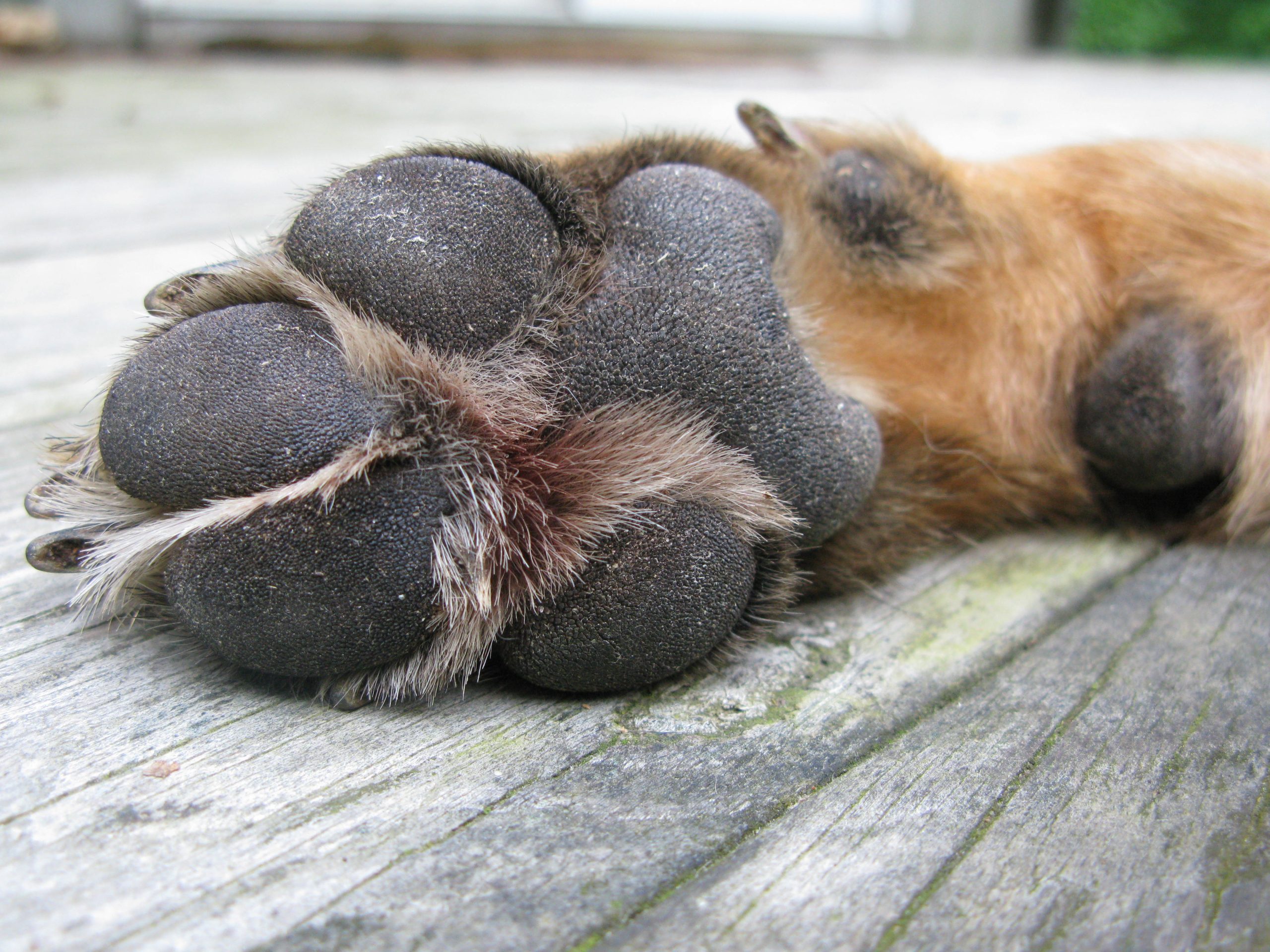
I have studied her paws and her paw prints (such as her tracks in the snow):

Paw of German Shepherd

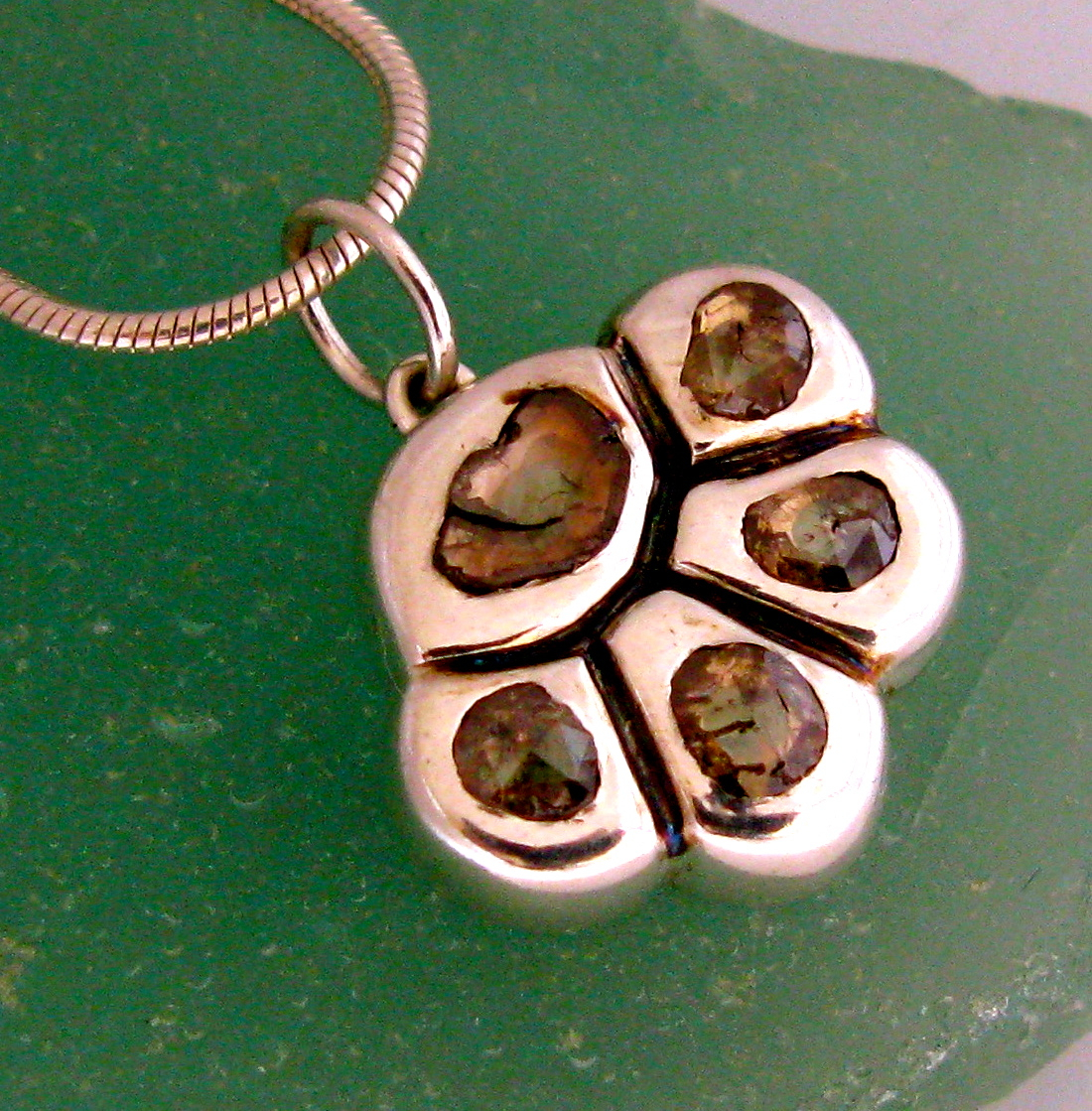
And here is an example of jewelry depicting her paw. This one is in Sterling silver with chocolate diamonds. It is a pendent about 3/4 inches in diameter and hangs on a silver chain:

Dog paw pendent with chocolate diamonds

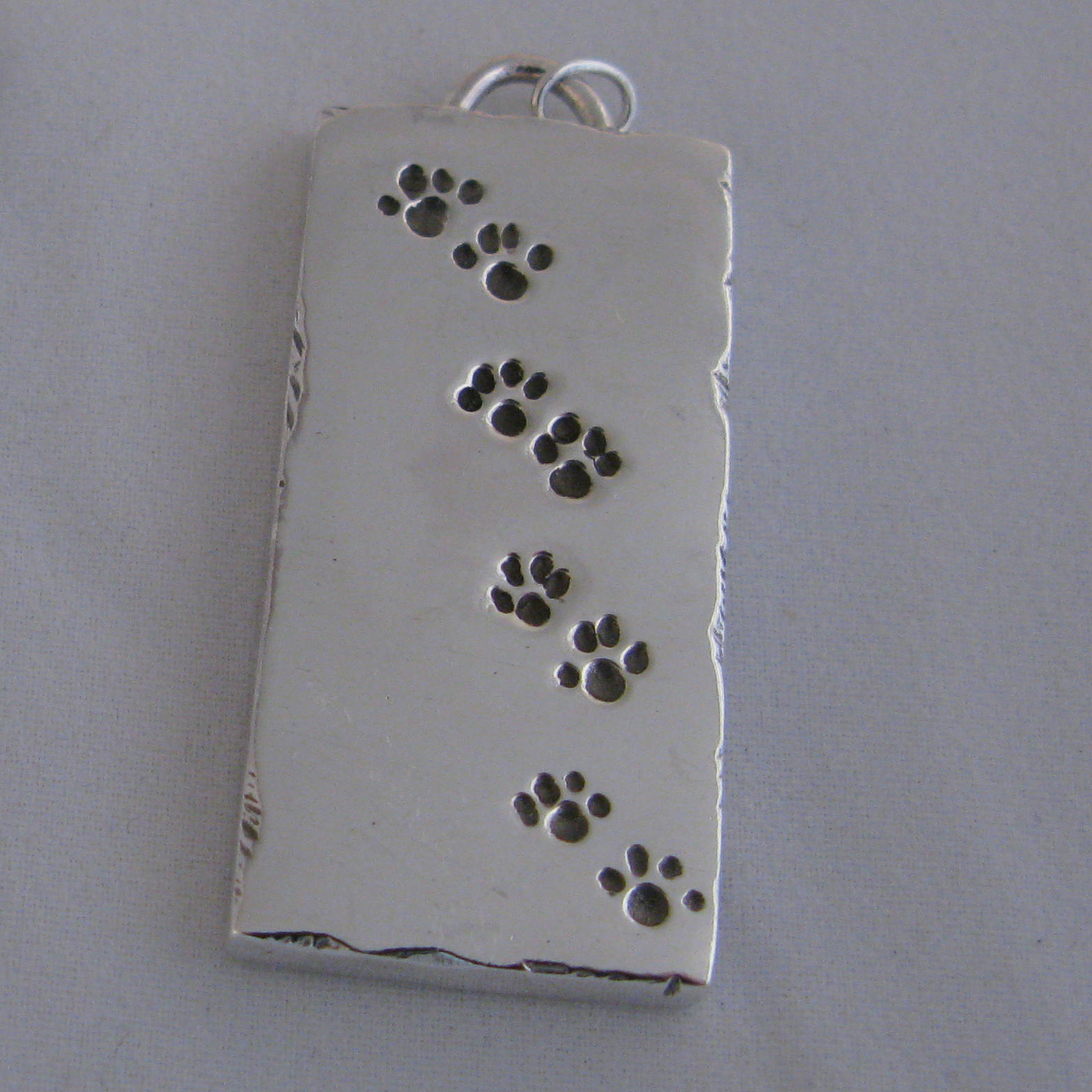
This is a small silver plaque with paw prints etched on it. The idea came from my fantastic dog trainer, Gail Murphy. Kenda loves Gail more than anyone. You can have the name of your dog etched or hammered on to this plaque. This pendent was recommended by our local news e-media, the patch.com, as a Christmas gift.

Dog Paw Tracks

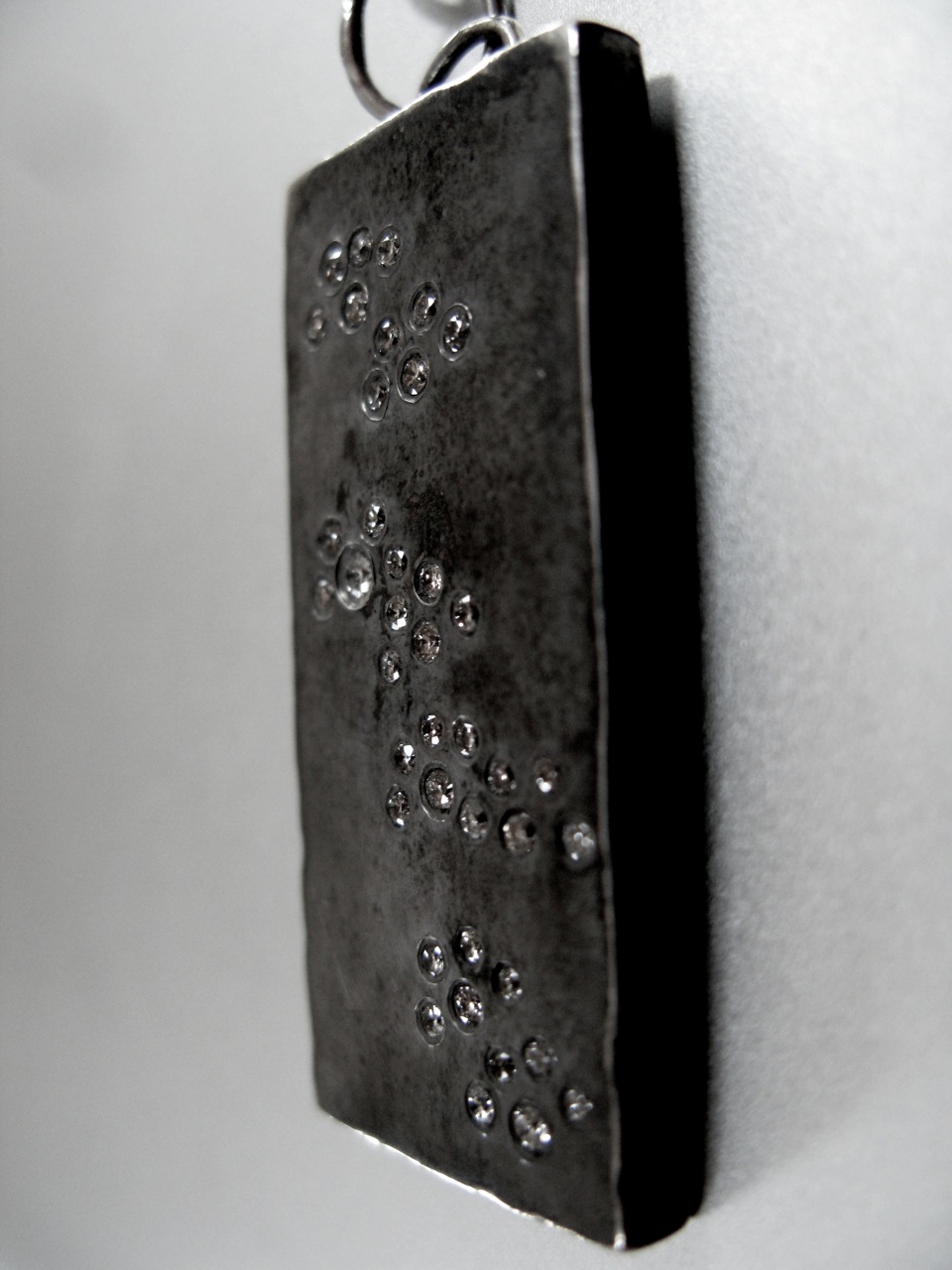
And here is an expensive dog tag with 40 little diamonds!

Diamond Dog Tag

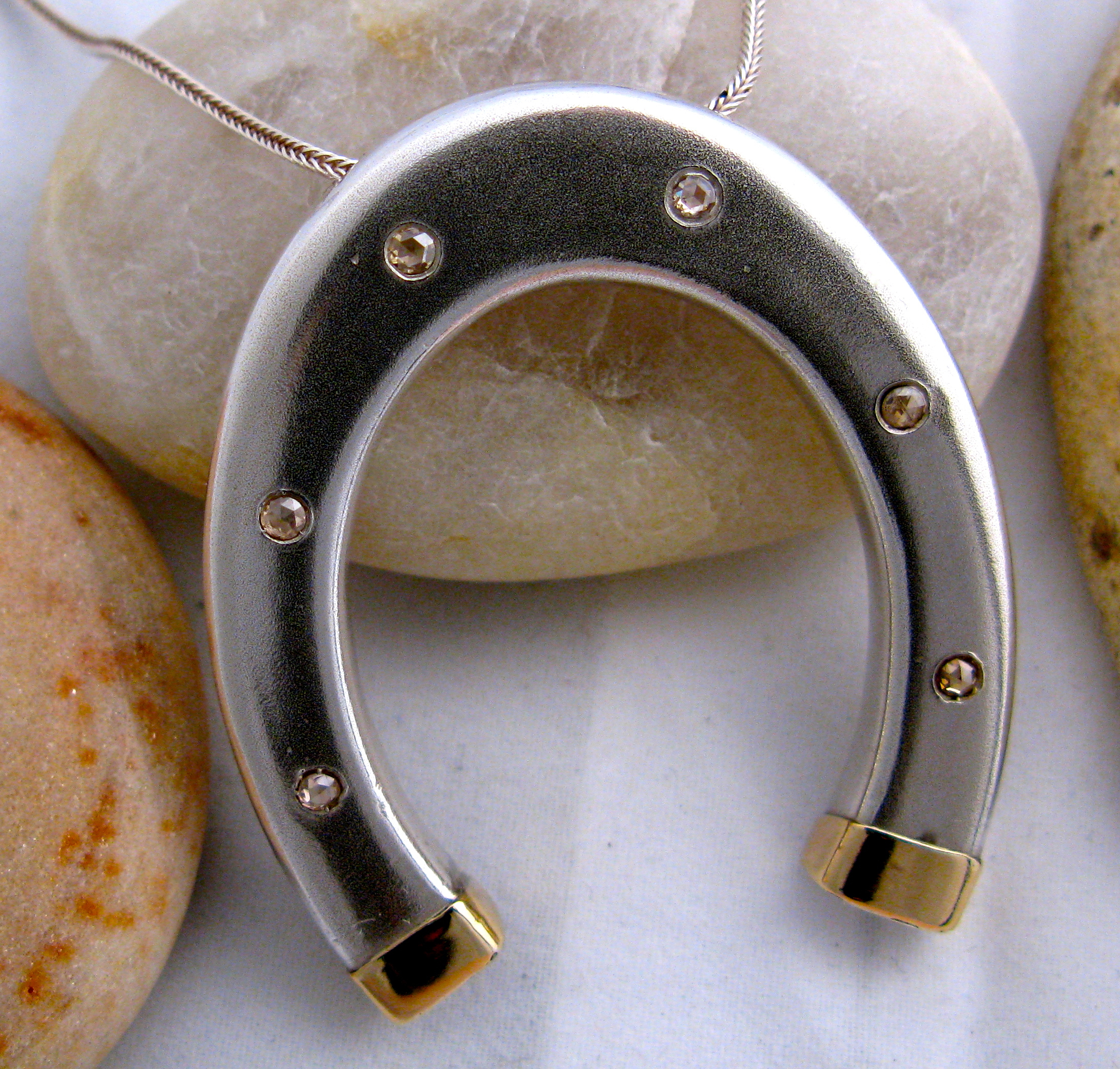
For the equestrian horse enthusiasts, here is a horse shoe in Sterling silver with gold caps and diamond nails!  Personal variations are quite in order.  One customer ordered this item with blue sapphires to emulate the horse shoe symbol of the Baltimore Colts football team!

Horse Shoe Pendent

Horse Shoe Pendent

I would really love to hear from you, specially all of you with pets.

Snake rings

My 15 year old daughter is going through a rebel phase. She talks about tattoos and piercings and she wanted a snake ring! So I made her a ring in silver with a chocolate diamond on its head and little ruby eyes:

Snake ring

This got me thinking and researching on the web. I found that present day celebrities and Hollywood personalities are also in to snake rings.
Nicole Richie, Angelina Jolie, Adam Lambert (of American Idol fame), Paris Hilton, Heidi Klum, Elisabeth Taylor, Jennifer Lopez, and even Michelle Obama own serpent rings and many can be seen on the web if you just google their names.

The fictitious character of Lucius Malfoy (from the Harry Potter series) also sports a snake ring, presumably as a reminder of his Slytherin House heritage. The Potter stories are rife with allusions to serpent mythology. Both Harry and He-Who-Must–Not–Be-Named speak Parseltongue (the language of snakes) and the monster snake Nagini, has a central role in the series.

So I wondered where this trend comes from. Romans and Greeks may have started the trend, but it was Queen Victoria herself who famously received a gold snake ring, meant to give good luck, as an engagement ring from Prince Albert. At that time serpent rings were very popular. The snake motif, was believed to be the sign of eternal love.

Interestingly, serpents are part of the mythology of nearly every human culture. These mythical creatures can be threatening and bad (the snake in the story of Adam and Eve), but they can also be good and comforting, such as the snake on the staff of Aesculapius, the mythical greek healer, which is now the emblem of modern day medicine.

If you are in to psychology there is tons of stuff on snakes. In particular C.G. Jung was fascinated by the Ouroboros, an ancient symbol showing a serpent eating its own tail. One drawing of the Ourobouros dates back to Cleopatra. This symbol shows up in an amazing number of different historical civilizations: ancient Egypt, Greece, Rome, India (Kundalini energy in Yoga), Aztec and Toltec ruins in Mexico, Norse mythology, Alchemists, Freemasonry, and West African religions…The Wiki site has more details and references.

In current times, however, I think the trend to wear a snake ring is either due to a fascination with reptiles (my 15 year old would have a pet snake if I allowed it) or it is a manifestation of rebellion and counterculture. This fits well with general teen behavior, but also with the bad boy image of Adam Lambert, the tumultuous life of Nicole Richie, and the rebellious history of Angelina Jolie who famously once said “I am…just a punk kid with tattoos”.

To see more recent work visit us on Etsy or on our MSJ website.

Conflict Free Diamonds: Really?

For those of us who love diamonds but want only to deal with conflict free diamonds, recent news from Zimbabwe is of concern. It is a good time to review the Kimberley Process and ask whether you can be sure where your diamond comes from!

The Kimberley Process is an alliance of industry, civic and government officials set up to stop the flow of so-called blood diamonds. The process regulates the sale of rough diamonds on an exchange. All lots of diamonds must be Kimberley certified. Only Kimberley certified diamonds are sold in the United States and some 70 other countries that are members of the Kimberley Process.

The Marange fields in Zimbabwe were discovered in 2006. De Beers obtained a concession to mine these fields but let this lapse, due perhaps to the political crisis in Zimbabwe. A frenzied diamond rush ensued by starving and impoverished miners desperately seeking relief from the country’s ongoing humanitarian crises. A thriving black market followed with an estimated 15,000 to 20,000 illegal artisan miners working the land and illegally selling their diamond finds to dealers outside the country.

Marange diamonds are mostly of lower quality (providing for industrial diamonds), but about 5% are gem quality and the mine field could yield up to 1.7 billion US$ in annual earnings representing more than a third of the entire gross national product (GNP) of Zimbabwe. The mine is state-owned and the income goes directly to support Robert Mugabe as the mines are overseen by his party, ZANU-PF, and guarded by an army that reports to him.

Herein lies the problem. Zimbabwe’s Diamond Fields were appropriated forcefully by Mugabe’s people using extreme cruelty. Currently, the diamonds are sold on the black market by his associates including Zimbabwe’s armed forces and the riches support him, his army and his party. A Human Rights Watch report charged that the military killed more than 200 miners and used the push to seize the Marange fields. Moreover the party, ZANU-PF, has used the money from diamonds — smuggled out of the country or illegally sold through the Reserve Bank — to reinforce its hold over the security forces, which seemed to be slipping last year as the value of soldiers’ pay collapsed with soaring inflation. In Dec 2009 there were riots by disaffected soldiers because of lack of pay. Army brigades are being rotated into the diamond fields, so more soldiers can profit from the illegal trade. Villagers from the area, some of them children, are being forced to work in mines controlled by military syndicates and have complained of being harassed, beaten and arrested, the report says.

The World Federation of Diamond Bourses, an umbrella group of 28 bourses in 20 countries, called on its members in April not to trade diamonds that originate in the Marange deposits in Zimbabwe. And now the issue is before the Kimberly Commission which supposedly assures us that diamonds are “conflict free”. To review how the Kimberly Process works here is a bit of history!

Following the resumption of the Angolan civil war by UNITA, a rebel group in Angola, the United Nations passed sanctions that remained ineffective. The UN then empowered Robert Fowler (a Canadian ambassador to the UN) to lead a panel of experts to investigate. UNITA used a number of channels to sell or barter diamonds for cash or weapons. In one such scheme, Joe de Deker, a former stockholder in De Beers, worked with the government of Zaire to supply military equipment to UNITA from 1993 to 1997. De Deker’s brother, Ronnie, was an arms dealer who allegedly traveled with him from South Africa to Angola, trading weapons originating in Eastern Europe. In return, UNITA gave Ronnie bushels of diamonds worth US$6 million. De Deker sent the diamonds to De Beer’s buying office in Antwerp, Belgium. De Beers openly acknowledges spending $500 million on legal and illegal Angolan diamonds in 1992 alone. UNITA made at least $3.72 billion, or 93% of all diamond sales, despite international sanctions.

The Fowler report led to a meeting of Southern African diamond-producing states in Kimberley, Northern Cape in May 2000 and later to the passing of United Nations Security Council Resolution 1295 and the establishment of the Kimberley Process.

In order for a country to be a participant, it must make sure that any diamond originating from the country does not finance a rebel group or other entity seeking to overthrow a UN-recognized government, that every diamond export be accompanied by a Kimberley Process certificate and that no diamond is imported from, or exported to, a non-member of the scheme. By restricting diamond revenues to government-approved sources, the Kimberley Process supports all governments, bad ones and good ones! It also denies revenues to all rebel groups, bad ones and potentially good ones fighting against a repressive regime! The Kimberly scheme is only a soft law and not legally binding. However, failure to comply has led to removal of the non-complying member countries in several cases.

The Kimberly scheme is essentially self-enforced. Supervision of the process is by the Chair, elected on an annual basis at a plenary meeting. This year we have a new chairing country: Israel. Peer review is conducted by a team of experts. They visit member countries and inspect implementation of the scheme. But all of this does not help when the offending party is a government itself, and not a rebel group. This is because the Kimberley Process was not set up to deal with governments like the one headed for many years by Robert Mugabe in Zimbabwe, arguably one of the most cruel and repressive governments on the globe.

As deliberations dragged on in Israel last week, Zimbabwe warned that it might export its diamonds without the approval of the United Nations-backed Kimberley Process. Moreover, there is a divide among the 70 countries that take part in the Kimberley Process. Some take the side of the Mugabe government, as summed up in a opinion piece by Stephen Gowans, and published in the official newspaper of the Zimbabwe government, The Herald, on June 30th 2010.

As reported on June 24th in the New York Times, “a sub-group of the Kimberley Process will try again next month to reach a compromise on Zimbabwe, said Eli Izhakoff, president of the World Diamond Council. He said it would be a very negative development if Zimbabwe traded its diamonds illegally, possibly undermining consumer confidence”.

We could not agree more! The designation “Kimberley Certified” risks becoming meaningless. Whether the perpetrators of violence are a rebel group or a repressive regime is of no concern to the customer. It is good to remember that ultimately the violent strife in Zimbabwe or elsewhere, is funded by the customer buying a diamond ring. Many will see Zimbabwe diamonds as “blood diamonds”.

Sources and further reading:
1) Zimbabwe’s Diamond Fields Enrich Ruling Party, Report Says
By CELIA W. DUGGER, Published: June 26, 2009

2) Diamond Find Could Aid Zimbabwe, and Mugabe
By CELIA W. DUGGER, Published: June 21, 2010

3) Zimbabwe Diamonds Fail to Get Conflict-Free Approval
By CELIA W. DUGGER, Published: June 24, 2010

4) Background: Zimbabwe’s Marange Diamond Mines, by Martin Rapaport.

5) Zimbabwe: Diamonds, When Regime Change is Forever.
Stephen Gowans, June 30, 2010, The Herald (Harare)
Published by the government of Zimbabwe