Category Archives: Gemology

JEWELRY FOR ANIMAL LOVERS

We recently saw an amazing documentary: “Cave of Forgotten Dreams” by Werner Herzog. This film describes artwork created some 30,000 to 40,000 years ago at a time when woolly mammoths reigned. The depictions of animals, such as horses, rhinoceros, and lions, are incredibly sophisticated and the artist even employs animation methods to give the impression of movement. I take this as evidence that animals have long been a favored subject of artists, even when we were still cave dwellers.

During the Renaissance, Albrecht Durer (1471 – 1528) was a master artist famous for his prints. Beautifully detailed pictures of animals (and plants) testify to his love of nature. Interestingly Albrecht’s father was a goldsmith.

Shah Jahan, famous for building the Taj Mahal, had a fabulous statue of his falcon made. It is completely covered in precious jewels. I saw this piece in the Museum of Islamic Art in Doha, Qatar, and have previously posted on this topic. So I take it that jewelry representing your favorite pet is an age-old thing!

I have a favorite pet too. My dog Kenda, a two year old german shepherd:

Kenda

I have studied her paws and her paw prints (such as her tracks in the snow):

Paw of German Shepherd

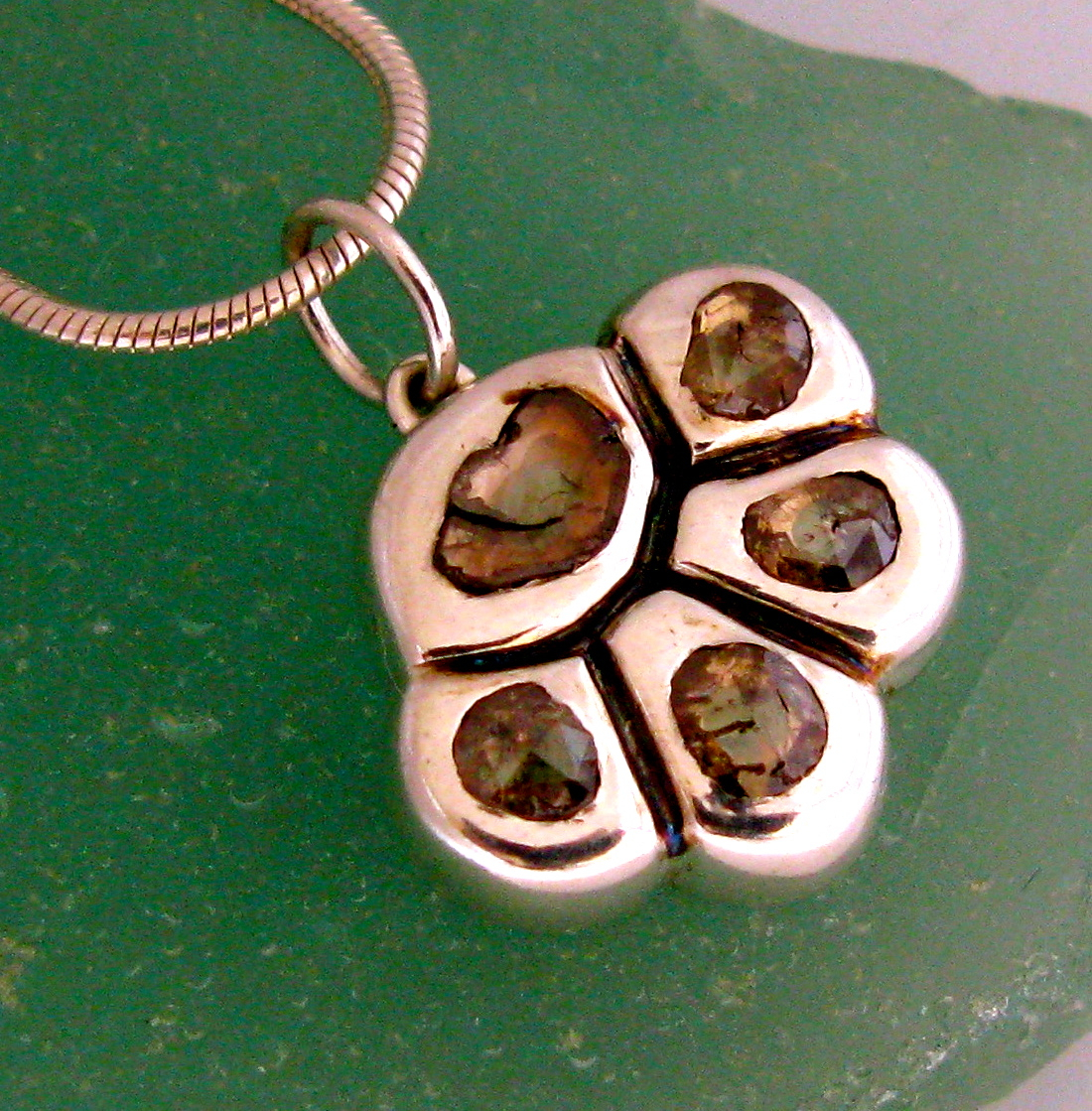
And here is an example of jewelry depicting her paw. This one is in Sterling silver with chocolate diamonds. It is a pendent about 3/4 inches in diameter and hangs on a silver chain:

Dog paw pendent with chocolate diamonds

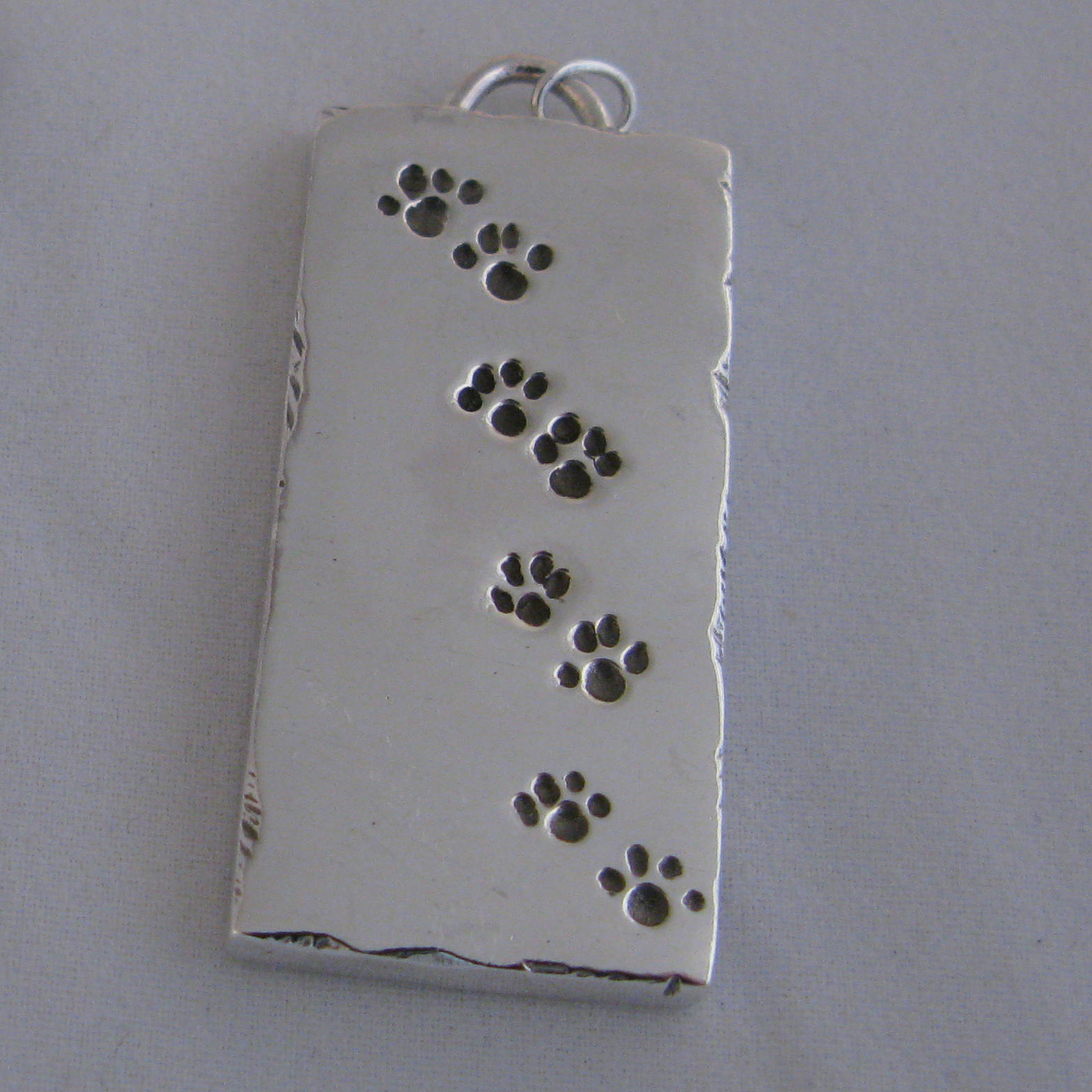
This is a small silver plaque with paw prints etched on it. The idea came from my fantastic dog trainer, Gail Murphy. Kenda loves Gail more than anyone. You can have the name of your dog etched or hammered on to this plaque. This pendent was recommended by our local news e-media, the patch.com, as a Christmas gift.

Dog Paw Tracks

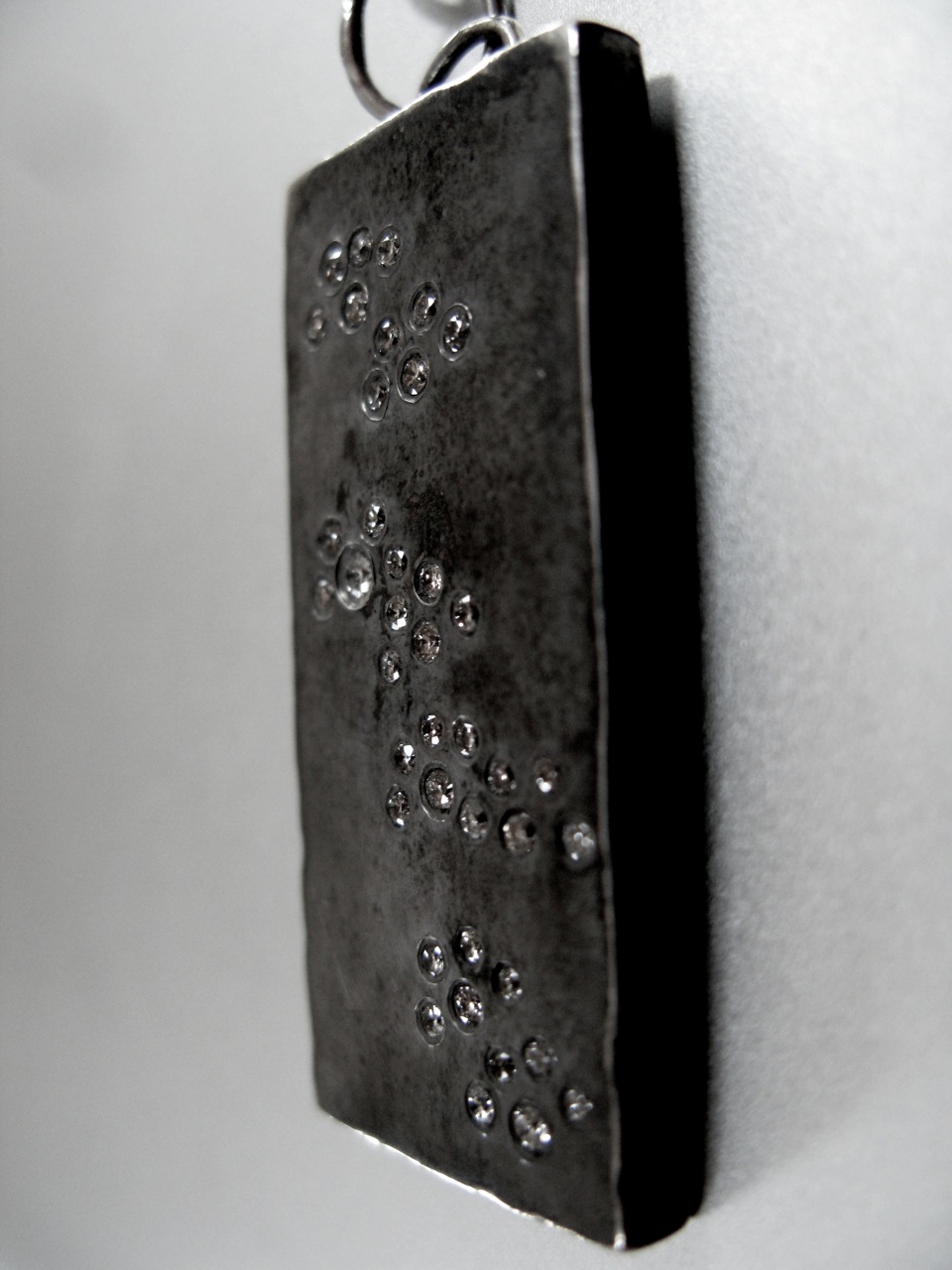
And here is an expensive dog tag with 40 little diamonds!

Diamond Dog Tag

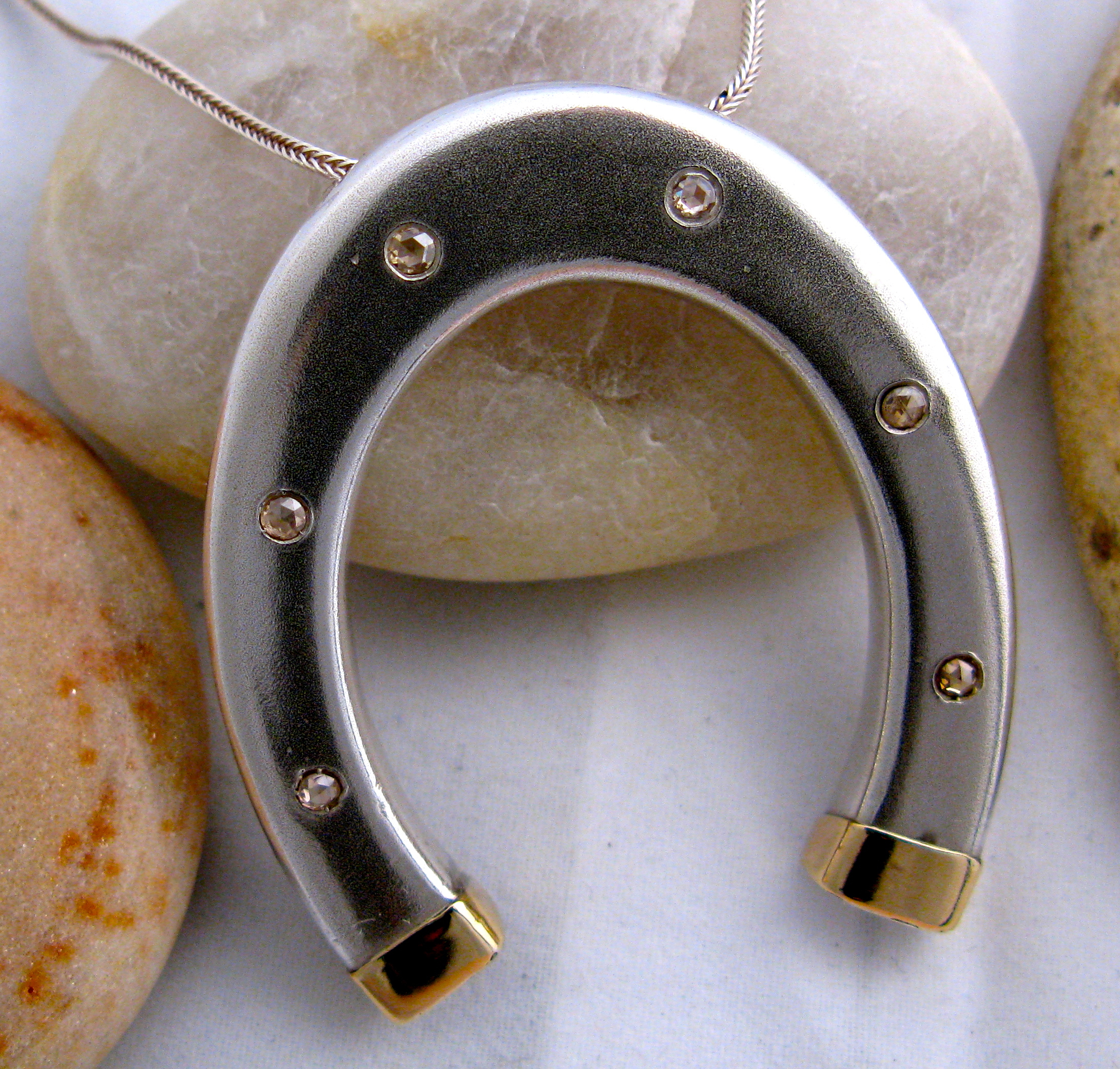
For the equestrian horse enthusiasts, here is a horse shoe in Sterling silver with gold caps and diamond nails!  Personal variations are quite in order.  One customer ordered this item with blue sapphires to emulate the horse shoe symbol of the Baltimore Colts football team!

Horse Shoe Pendent

Horse Shoe Pendent

I would really love to hear from you, specially all of you with pets.

Conflict Free Diamonds: Really?

For those of us who love diamonds but want only to deal with conflict free diamonds, recent news from Zimbabwe is of concern. It is a good time to review the Kimberley Process and ask whether you can be sure where your diamond comes from!

The Kimberley Process is an alliance of industry, civic and government officials set up to stop the flow of so-called blood diamonds. The process regulates the sale of rough diamonds on an exchange. All lots of diamonds must be Kimberley certified. Only Kimberley certified diamonds are sold in the United States and some 70 other countries that are members of the Kimberley Process.

The Marange fields in Zimbabwe were discovered in 2006. De Beers obtained a concession to mine these fields but let this lapse, due perhaps to the political crisis in Zimbabwe. A frenzied diamond rush ensued by starving and impoverished miners desperately seeking relief from the country’s ongoing humanitarian crises. A thriving black market followed with an estimated 15,000 to 20,000 illegal artisan miners working the land and illegally selling their diamond finds to dealers outside the country.

Marange diamonds are mostly of lower quality (providing for industrial diamonds), but about 5% are gem quality and the mine field could yield up to 1.7 billion US$ in annual earnings representing more than a third of the entire gross national product (GNP) of Zimbabwe. The mine is state-owned and the income goes directly to support Robert Mugabe as the mines are overseen by his party, ZANU-PF, and guarded by an army that reports to him.

Herein lies the problem. Zimbabwe’s Diamond Fields were appropriated forcefully by Mugabe’s people using extreme cruelty. Currently, the diamonds are sold on the black market by his associates including Zimbabwe’s armed forces and the riches support him, his army and his party. A Human Rights Watch report charged that the military killed more than 200 miners and used the push to seize the Marange fields. Moreover the party, ZANU-PF, has used the money from diamonds — smuggled out of the country or illegally sold through the Reserve Bank — to reinforce its hold over the security forces, which seemed to be slipping last year as the value of soldiers’ pay collapsed with soaring inflation. In Dec 2009 there were riots by disaffected soldiers because of lack of pay. Army brigades are being rotated into the diamond fields, so more soldiers can profit from the illegal trade. Villagers from the area, some of them children, are being forced to work in mines controlled by military syndicates and have complained of being harassed, beaten and arrested, the report says.

The World Federation of Diamond Bourses, an umbrella group of 28 bourses in 20 countries, called on its members in April not to trade diamonds that originate in the Marange deposits in Zimbabwe. And now the issue is before the Kimberly Commission which supposedly assures us that diamonds are “conflict free”. To review how the Kimberly Process works here is a bit of history!

Following the resumption of the Angolan civil war by UNITA, a rebel group in Angola, the United Nations passed sanctions that remained ineffective. The UN then empowered Robert Fowler (a Canadian ambassador to the UN) to lead a panel of experts to investigate. UNITA used a number of channels to sell or barter diamonds for cash or weapons. In one such scheme, Joe de Deker, a former stockholder in De Beers, worked with the government of Zaire to supply military equipment to UNITA from 1993 to 1997. De Deker’s brother, Ronnie, was an arms dealer who allegedly traveled with him from South Africa to Angola, trading weapons originating in Eastern Europe. In return, UNITA gave Ronnie bushels of diamonds worth US$6 million. De Deker sent the diamonds to De Beer’s buying office in Antwerp, Belgium. De Beers openly acknowledges spending $500 million on legal and illegal Angolan diamonds in 1992 alone. UNITA made at least $3.72 billion, or 93% of all diamond sales, despite international sanctions.

The Fowler report led to a meeting of Southern African diamond-producing states in Kimberley, Northern Cape in May 2000 and later to the passing of United Nations Security Council Resolution 1295 and the establishment of the Kimberley Process.

In order for a country to be a participant, it must make sure that any diamond originating from the country does not finance a rebel group or other entity seeking to overthrow a UN-recognized government, that every diamond export be accompanied by a Kimberley Process certificate and that no diamond is imported from, or exported to, a non-member of the scheme. By restricting diamond revenues to government-approved sources, the Kimberley Process supports all governments, bad ones and good ones! It also denies revenues to all rebel groups, bad ones and potentially good ones fighting against a repressive regime! The Kimberly scheme is only a soft law and not legally binding. However, failure to comply has led to removal of the non-complying member countries in several cases.

The Kimberly scheme is essentially self-enforced. Supervision of the process is by the Chair, elected on an annual basis at a plenary meeting. This year we have a new chairing country: Israel. Peer review is conducted by a team of experts. They visit member countries and inspect implementation of the scheme. But all of this does not help when the offending party is a government itself, and not a rebel group. This is because the Kimberley Process was not set up to deal with governments like the one headed for many years by Robert Mugabe in Zimbabwe, arguably one of the most cruel and repressive governments on the globe.

As deliberations dragged on in Israel last week, Zimbabwe warned that it might export its diamonds without the approval of the United Nations-backed Kimberley Process. Moreover, there is a divide among the 70 countries that take part in the Kimberley Process. Some take the side of the Mugabe government, as summed up in a opinion piece by Stephen Gowans, and published in the official newspaper of the Zimbabwe government, The Herald, on June 30th 2010.

As reported on June 24th in the New York Times, “a sub-group of the Kimberley Process will try again next month to reach a compromise on Zimbabwe, said Eli Izhakoff, president of the World Diamond Council. He said it would be a very negative development if Zimbabwe traded its diamonds illegally, possibly undermining consumer confidence”.

We could not agree more! The designation “Kimberley Certified” risks becoming meaningless. Whether the perpetrators of violence are a rebel group or a repressive regime is of no concern to the customer. It is good to remember that ultimately the violent strife in Zimbabwe or elsewhere, is funded by the customer buying a diamond ring. Many will see Zimbabwe diamonds as “blood diamonds”.

Sources and further reading:
1) Zimbabwe’s Diamond Fields Enrich Ruling Party, Report Says
By CELIA W. DUGGER, Published: June 26, 2009

2) Diamond Find Could Aid Zimbabwe, and Mugabe
By CELIA W. DUGGER, Published: June 21, 2010

3) Zimbabwe Diamonds Fail to Get Conflict-Free Approval
By CELIA W. DUGGER, Published: June 24, 2010

4) Background: Zimbabwe’s Marange Diamond Mines, by Martin Rapaport.

5) Zimbabwe: Diamonds, When Regime Change is Forever.
Stephen Gowans, June 30, 2010, The Herald (Harare)
Published by the government of Zimbabwe


WEDDING RINGS

I have been wondering about wedding rings. Why do we wear them? When and how did this tradition originate?

Jewelry itself is as old as mankind. Prehistoric artifacts from 82,000 years ago have shown that homo sapiens in Marocco, and perhaps homo neanderthal too, made necklaces of perforated sea shells. A nice picture is found on page 8 of “Jewelry: from antiquity to the Present” depicting a necklace of perforated clam shells and small animal bones from 38,000 BC. That is before the last ice age and that is when woolly mammoths roamed across America. Along with necklaces of teeth and bones of hunted prey, these items possibly served as powerful talismans to be worn by the hunter and not just for decorative purposes. Special protection and powers from deities were expected.

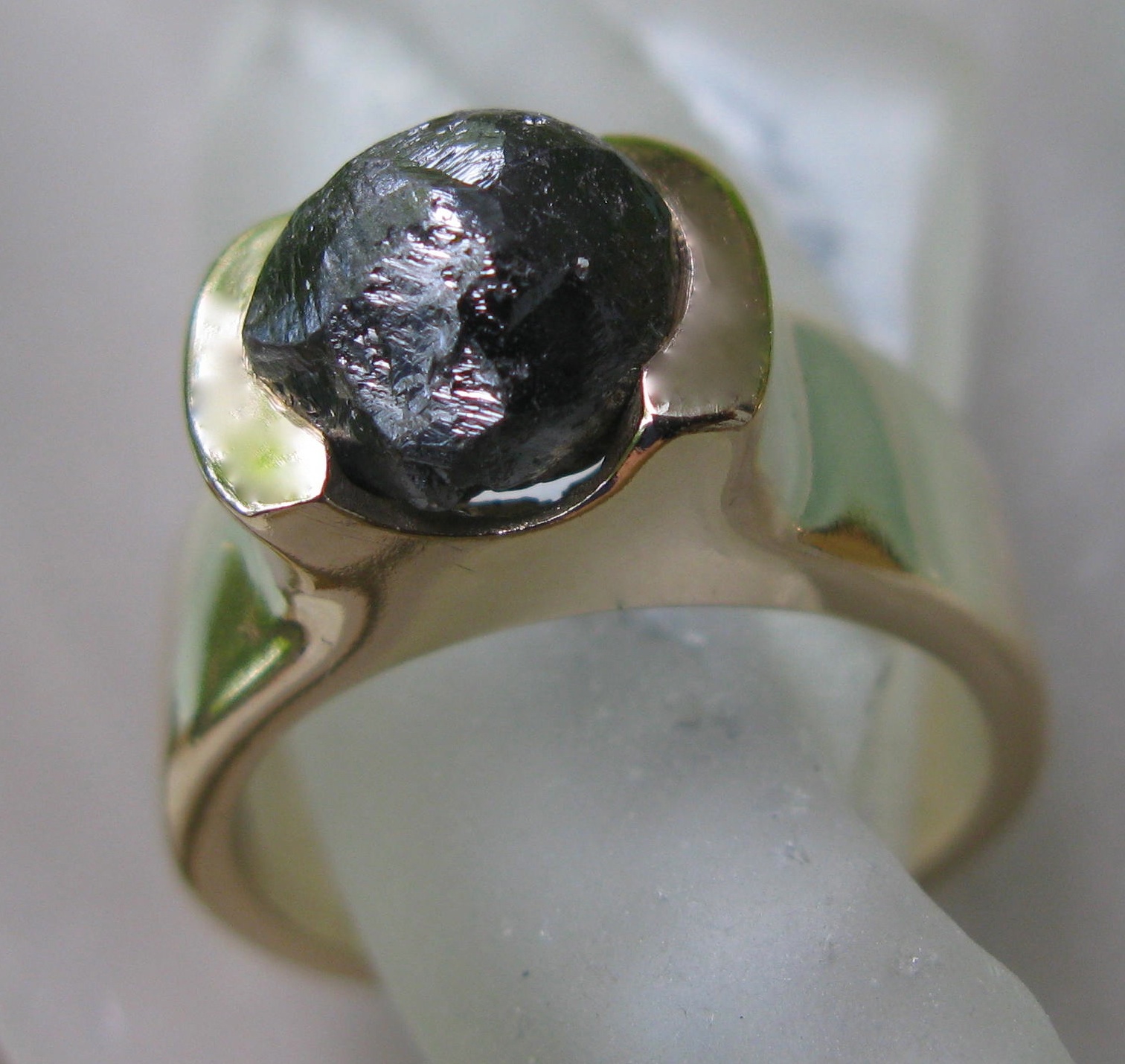
7 Karat Black Diamond in the Rough in a gold ring (engagement ring)

Common lore portends that early Egyptians first used wedding bands fashioned of reeds from the banks of the Nile perhaps around 4000 BC. They were replaced by metal rings as soon as metallurgy was discovered. Gold jewelry first appeared in Mesopotamia around 2500 BC. Many of the same jewelry techniques we use today, were already in use in antiquity including repoussee, granulation and wax techniques using gypsum molds. At the royal tombs of Ur in Mesopotamia, Queen Pu-abi, for instance, wore a ring on each finger and among her 63 attendants buried with her, the women wore intricate headbands, ear rings, necklaces, bracelets and rings and the men wore ear rings, necklaces, armlets, bracelets and pectoral ornaments. At the site of ancient Troy a treasure of jewelry was found including 8000 small rings dating 2200 BC. In Egypt scarab rings were particularly common and served as a portable seal with a hieroglyph signature. You can see many samples in the Metropolitan Museum of New York and other museums of antiquity.

In ancient Rome , marriage rings became a symbol of a contract. Iron was adopted as the metal of choice rather than copper, brass or gold. Acceptance of the rings was considered legally binding. The betrothal ring was usual, but not required and was exchanged prior to the wedding like an engagement ring. It signified eternal commitment and was worn on the left ring finger because the vein of this finger (vena amoris) was thought to lead directly to the heart. In the later stages of roman civilization excessive gold rings were sported.

It was the church that then bestowed religious significance on the wedding rings with benediction of the rings beginning in the 11th century. In Jewish texts reference to rings may be much earlier. This led to our current day religious ceremonies:
Church of England (1662 Book of Common Prayer) – “With this ring I thee wed, …
Judaism – “With this ring, you are consecrated to me according to the law of Moses and Israel.”
Roman Catholic – “… take this ring as a sign of my love and fidelity. In the name of the Father, and of the Son, and of the Holy Spirit.”
Eastern Orthodox – “The servant of God (name) is betrothed to the handmaid of God (name), in the Name of the Father, and of the Son, and of the Holy Spirit. Amen.” said three times while the Priest makes the Sign of the Cross with the ring over the bridegroom’s and then the bride’s head.

But some religions frown on wedding rings. Quakers in particular, who claim the tradition is heathen. And Muslims, who either quote the prophet: “Wearing gold is forbidden for male Muslims, but it is allowed for female Muslims” or decry this western tradition.

Never the less, present day customs across the world nearly all involve some kind of wedding rings, although there are many amusing curiosities. In some countries wedding rings are worn on the right hand rather than on the left ring finger. In the Netherlands Catholics wear it on the left and Protestants on the right! Hindus sometimes wear a toe ring called bichiya. In east Bengal a bangle is worn by married women, in stead of a ring. Traditional Russian wedding rings are three interlocking bands of rose, white and yellow gold, worn on the right hand.

Champagne Heart Diamond in a Gold Ring

Wearing a wedding ring is not only a personal symbol of enduring commitment and eternal love, but also a public symbol, advertising marital and availability status. Every culture appears to have a set of customs by which women (and men to some extent) announce their availability. We came across a quaint custom on the Caribbean island of St. Lucia, where women wear a colorful head piece, called the Tête en l’air arranged with one or more peaks which represent various levels of romantic commitment: one peak means ‘my heart is free’, two peaks means ‘my heart is engaged but you can try’, three peaks mean ‘my heart is engaged and committed’, and four peaks means ‘anyone who tries is welcome’!

In discussing modern periods, a recent textbook on the history of jewelry concludes that “the major international [jewelry] houses have continued to work…following styles evolved from previous decades, [but that] innovation has come…from individual artist craftsmen trained at art schools”.

If you are looking for wedding rings, and public symbolism is important to you, you probably want to find a conventional and traditional set of engagement and wedding rings (that everyone will recognize as such). A nice custom is to use family heirloom rings from grandparents.

If on the other hand private symbolism and personal tastes are more important to the couple, there are some interesting modern day trends. You can personalize your rings by incorporating your fingerprints on your rings, or hidden messages to each other, or get a set of rings that join like puzzle pieces, and you can check out at least 500 other imaginative ideas! Working with a custom jeweler/artist you can make tailor-made rings to suit your special needs. It does not have to be expensive. Remember, the major expense in wedding/engagement rings is the gem (diamond) accounting for approx. >70% of the final price. Check out our website for more on this!

Take care, David

4 colored rough diamonds set in a silver wedding band

4 colored rough diamonds set in a silver wedding band